 KEY-IOT
BUSCAR
- 葡萄酒 | 威士忌 | 白兰地 | 啤酒 -
- 葡萄酒 | 威士忌 | 白兰地 | 啤酒 -
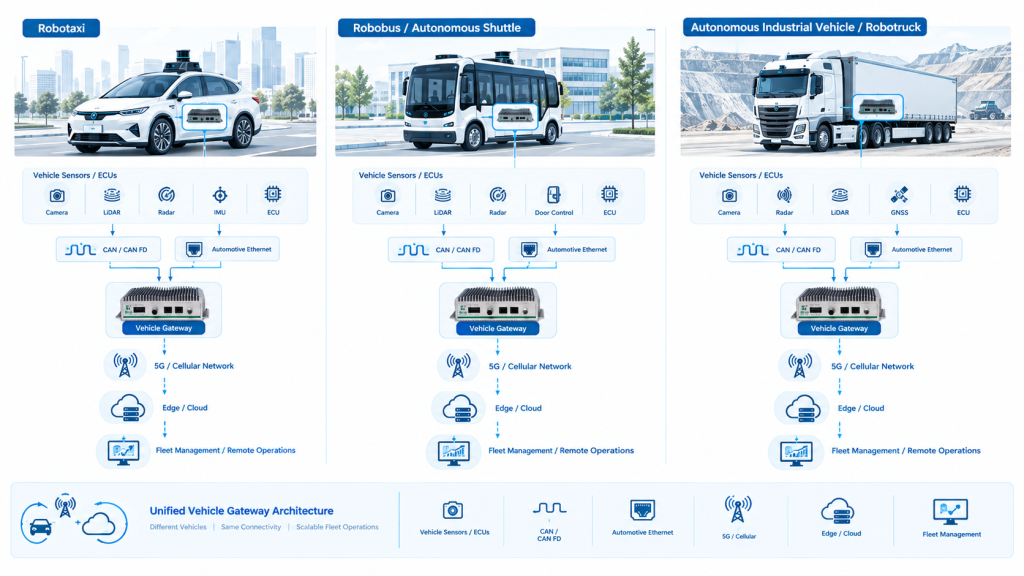
A vehicle gateway does not have a single role across every autonomous vehicle.
A Robotaxi, Robobus, Robotruck, and autonomous mining truck may all require 5G connectivity, but the communication architecture behind that connection can be very different. One vehicle may need high-bandwidth communication with an autonomous-driving computer. Another may place more emphasis on fleet operations and V2X. A mining truck may face much tougher environmental and coverage conditions than an urban passenger vehicle.
The difference starts with the vehicle’s E/E architecture.
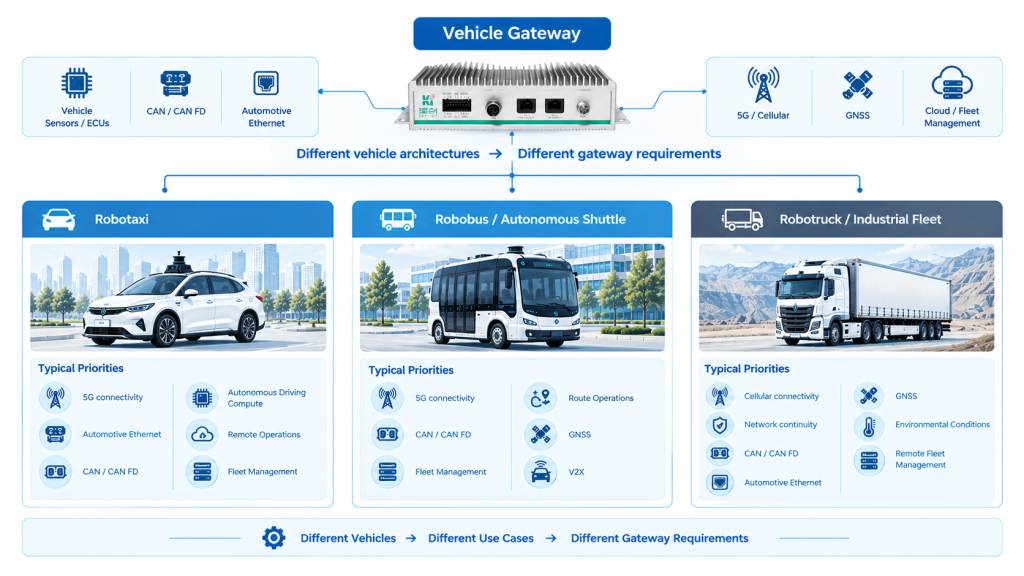
An onboard system can include ECUs, domain controllers, autonomous-driving computers, Ethernet switches, GNSS equipment, telematics functions, and cellular communication. Depending on the design, some of these functions may be integrated into one device while others remain separate.
That leads to a more useful starting point for gateway selection:
What needs to cross the vehicle’s network boundary?
If the answer is only internet access for an onboard computer, a conventional industrial router may be sufficient.
If the gateway also needs to connect CAN or CAN FD, automotive Ethernet, GNSS, cellular networks, and fleet platforms, the hardware and software requirements become very different.
The goal is therefore not to find one gateway specification for every autonomous fleet. It is to match the gateway architecture to the vehicle network, operating environment, and external communication requirements.
The same basic gateway functions can have very different importance depending on the vehicle.
For many autonomous vehicles, cellular connectivity is the main communication path to cloud platforms, fleet systems, or remote operations.
Depending on the deployment, the gateway may need 4G, 5G, SIM, eSIM, multiple SIMs, or multiple cellular modules.
These options should not be treated as equivalent.
Two SIM cards do not necessarily provide two independent cellular links. A dual-module architecture is a different design, while carrier aggregation is a separate modem capability.
For a fleet project, engineers should check:
The route also matters. A modem benchmark performed under strong coverage tells little about how a gateway will behave across the actual operating area.
CAN remains widely used for ECU and subsystem communication, while CAN FD can be used where larger payloads and higher data efficiency are needed.
The gateway may expose selected vehicle data to external systems or connect different network segments. It should not automatically be treated as the controller responsible for the vehicle function itself.
This distinction becomes important in autonomous vehicles.
For example, a gateway may carry status information from a vehicle controller to a fleet platform while the underlying control logic remains inside the ECU or domain controller.
Port count alone is therefore not enough. The engineering team should identify which CAN networks need to cross the gateway, what information needs to be exchanged, and how those networks are positioned within the E/E architecture.
Automotive Ethernet changes the gateway design when domain controllers, autonomous-driving computers, or other high-bandwidth systems use Ethernet as their vehicle network.
100BASE-T1 and 1000BASE-T1 can be part of this architecture, while conventional Ethernet may be used for service access, diagnostics, or external equipment.
The important question is not simply how many Ethernet ports a gateway has.
Engineers should map:
A gateway with more interfaces is not automatically the better choice. The interfaces need to match the network topology.
GNSS and network timing are related to vehicle connectivity, but they serve different functions.
GNSS provides positioning information for fleet tracking, navigation-related functions, and vehicle operations. Positioning performance depends on the receiver, antenna, correction source, and deployment environment.
PTP and gPTP address network timing.
Where multiple onboard devices need a common time reference, a gateway may participate in an IEEE 1588v2 or IEEE 802.1AS/gPTP architecture.
These two requirements should therefore be evaluated separately:
Does the vehicle need positioning?
Does the vehicle network need synchronized time?
Neither GNSS nor PTP/gPTP should be presented as a substitute for the other, and neither by itself determines cellular end-to-end latency.
A gateway becomes more than a modem when it is responsible for traffic between several vehicle networks.
Depending on the architecture, useful functions can include:
These functions determine how traffic moves through the vehicle and over external links.
They are particularly useful when several applications share the same communication infrastructure. A production fleet may also need remote visibility into which interface, route, or link is carrying a problematic traffic flow.
The gateway requirements can change substantially with the vehicle type.
A Robotaxi generally operates in an urban road environment. A Robobus may follow fixed routes but remain outdoors for long periods. A mining truck can face vibration, temperature variation, dust, and demanding electrical conditions. A port vehicle can have yet another combination of environmental and network requirements.
The selection process should therefore include:
The product label alone is not enough. The published limits should be compared with the actual installation environment.
A gateway that works well in a prototype vehicle may create operational problems once hundreds of vehicles are deployed.
Fleet-scale operation can require:
This is particularly important when vehicles operate over large geographic areas. Physical access to a gateway for every diagnostic or software update task is rarely practical at fleet scale.
The most useful way to evaluate a gateway is to start with the vehicle application rather than treating “autonomous vehicle” as one hardware category.
A typical Robotaxi can include autonomous-driving compute, vehicle controllers, cameras and other sensors, positioning systems, connectivity, and remote fleet services.
A simplified communication architecture can be represented as:
Autonomous Driving Compute
↓
CAN / CAN FD / Automotive Ethernet
↓
Portal del vehículo
↓
5G / Cellular Network
↓
Cloud / Edge Platform
↓
Fleet Management / Remote Operations
The gateway provides the communication path. It is not the system responsible for perception, sensor fusion, path planning, or autonomous decision making.
Robotaxi projects may place particular emphasis on:
The test plan also needs to reflect the operating model. A vehicle used for remote assistance may need network measurements that cover latency, jitter, packet loss, and handover behavior rather than simply reporting peak cellular throughput.
Robobus and autonomous shuttle platforms share many of the same vehicle-network requirements as Robotaxi, but their operating pattern can be different.
A shuttle may operate repeatedly on defined routes and within a controlled service area. This can increase the importance of:
CAN and automotive Ethernet remain important for communication with onboard controllers.
The distinction is not that Robobus needs “less” communication than Robotaxi. The emphasis can simply move from remote assistance and high-volume onboard data toward fleet operations and route-level service continuity.
Robotrucks operate over longer routes and can experience larger changes in cellular conditions than a vehicle that stays within a relatively small urban operating area.
The gateway may therefore need closer attention to:
The physical installation also matters. Long operating cycles and larger vehicle electrical systems can change the gateway’s power and environmental requirements.
Mining trucks are a different engineering problem from urban autonomous passenger vehicles.
The gateway may need to coexist with local wireless infrastructure, dispatch systems, industrial control networks, fleet platforms, and remote monitoring.
At the same time, the vehicle itself can operate under significantly more demanding environmental conditions.
For mining and industrial vehicles, gateway selection should therefore consider:
Autonomous sweepers and other compact industrial vehicles can have another constraint: installation space and power consumption may be more important than extremely high cellular throughput.
The point is not that one application needs a “better” gateway than another. The vehicle architecture is different, so the gateway specification changes with it.
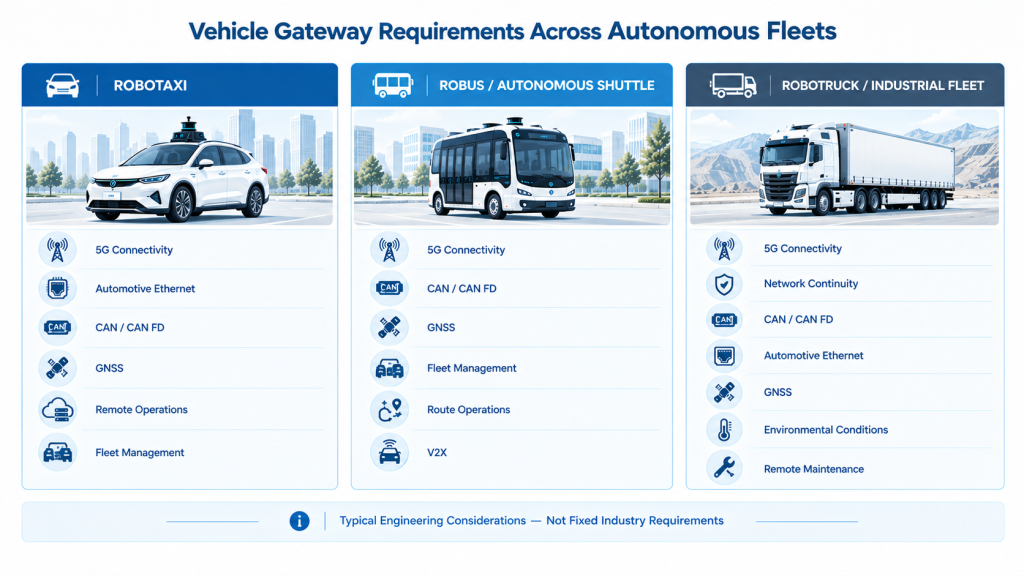
The following table summarizes typical engineering considerations rather than fixed industry requirements.
| Requisito | Robotaxi | Robobus / Shuttle | Robotruck / Industrial Fleet |
| 5G Connectivity | High | High | High |
| Ethernet para automoción | High | Medium–High | Medium–High |
| CAN / CAN FD | High | High | High |
| GNSS | High | High | High |
| Remote Operations | High | Medium–High | Medium–High |
| Environmental Requirements | Medium | Medium | High |
| Fleet Management | High | High | High |
| V2X | Deployment-dependent | Deployment-dependent | Deployment-dependent |
The reason behind each difference is more useful than the label itself.
For Robotaxi, automotive Ethernet and high-volume onboard data may be closely tied to the autonomous-driving compute architecture.
For Robobus, fleet operations and route management can have a greater operational role.
For Robotrucks and industrial vehicles, environmental conditions, cellular continuity, and long-term remote maintenance can become more prominent.
This is why an autonomous vehicle gateway should be selected from the actual deployment model rather than from an industry category alone.
A common mistake in gateway selection is to treat the gateway as the center of every vehicle network.
In practice, the role depends on the E/E architecture.
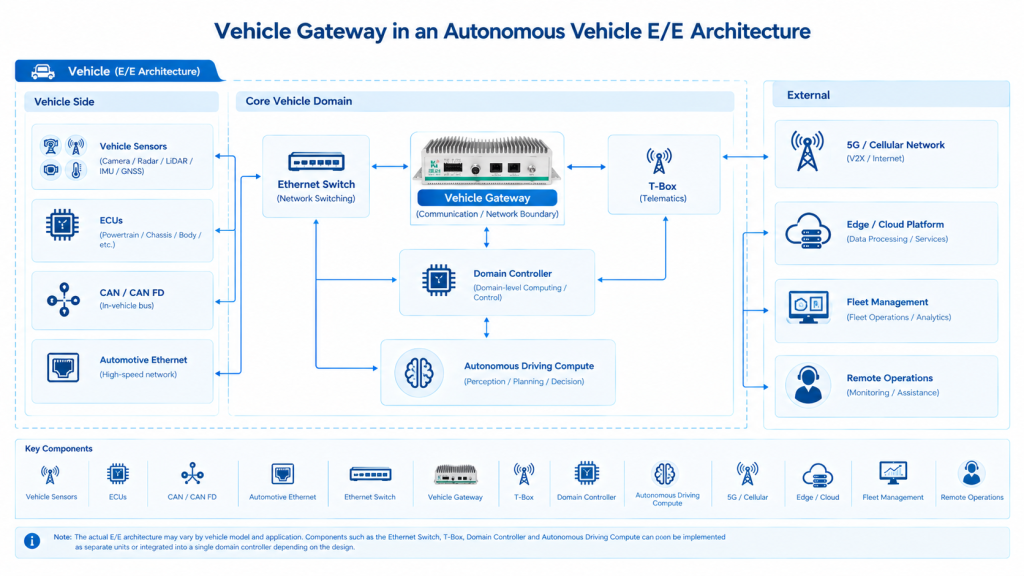
A simplified architecture might look like:
Vehicle Sensors / ECUs
↓
CAN / CAN FD / Automotive Ethernet
↓
Portal del vehículo
↓
5G / Cellular
↓
Edge / Cloud
↓
Fleet Management / Remote Operations
But production vehicles can use very different combinations of devices.
One platform may have separate:
Another architecture may integrate some of these functions.
That distinction has a direct impact on gateway selection.
A vehicle gateway should not automatically be treated as a replacement for a T-Box, Ethernet switch, or domain controller. A T-Box should not automatically be expected to provide the same vehicle-network functions as a gateway.
The useful architectural question is:
Which traffic needs to cross each network boundary?
That question determines where routing, firewalling, network segmentation, cellular access, and vehicle-network interfaces should reside.
SV910 is one example of an integrated vehicle communication platform that can be evaluated when an autonomous vehicle requires both cellular connectivity and vehicle-network interfaces.
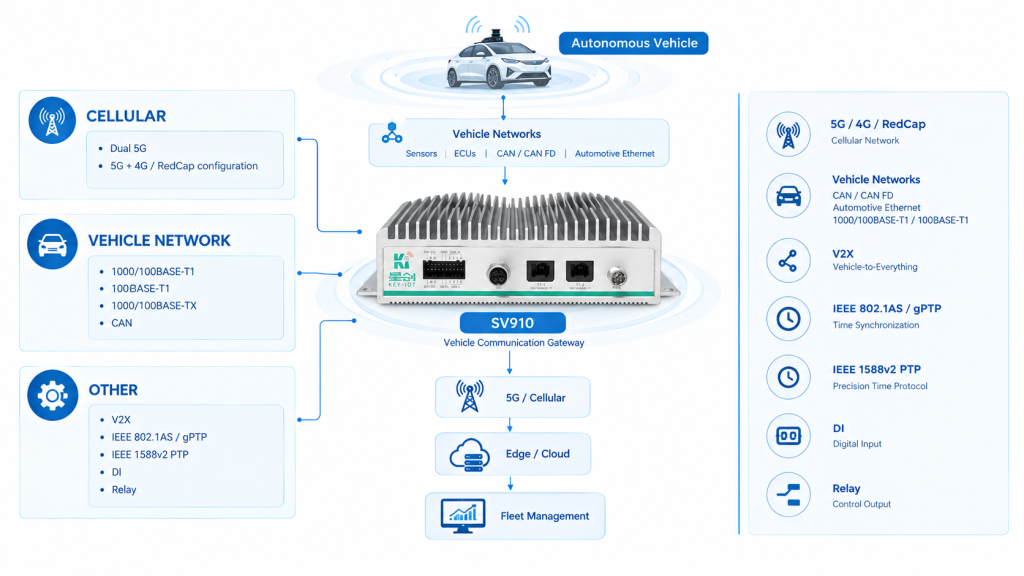
According to the published product information, SV910 supports dual-mode cellular configurations, including dual 5G and 5G + 4G/RedCap options.
For vehicle-network integration, the published interface configuration includes:
SV910 also provides V2X-related capabilities and supports IEEE 802.1AS/gPTP and IEEE 1588v2 PTP for vehicle network timing.
These capabilities can be mapped to common autonomous-vehicle requirements:
| Vehicle Requirement | Relevant SV910 Capability |
| Dual cellular connectivity | Dual-mode cellular configuration |
| Automotive Ethernet integration | 100BASE-T1 / 1000BASE-T1 |
| Conventional Ethernet | 1000/100BASE-TX |
| Vehicle network access | CAN |
| V2X deployment | V2X capability |
| Network timing | IEEE 802.1AS/gPTP, IEEE 1588v2 PTP |
| Vehicle-side I/O | DI and relay interfaces |
This does not make SV910 a universal gateway for every autonomous fleet.
Its suitability still depends on the vehicle topology, required interfaces, cellular deployment, operating environment, and software integration model.
The correct engineering sequence is:
Define the vehicle architecture → identify network boundaries → define communication requirements → map them to gateway capabilities.
The product should follow that process, not replace it.
Once the architecture is defined, procurement can move from general requirements to hardware validation.
| Selection Area | What to Check |
| Cellular | Modem architecture, frequency bands, SIM/eSIM, operator compatibility |
| Red de vehículos | CAN, CAN FD, 100BASE-T1, 1000BASE-T1, Ethernet topology |
| GNSS | Receiver capability, antenna, correction requirements |
| Timing | IEEE 1588v2, IEEE 802.1AS/gPTP requirements |
| Gestión de redes | VLAN, routing, link detection, link backup |
| Environment | Temperature, power, vibration, mounting |
| Software | Remote management, diagnostics, FOTA |
| Integration | APIs, documentation, network interfaces |
| Validation | Coverage, handover, packet loss, latency, vehicle tests |
| Lifecycle | Firmware maintenance and technical support |
Four questions are particularly useful during supplier evaluation.
Which networks actually need to connect through the gateway?
A project that only needs cellular internet access has different requirements from one that needs CAN and automotive Ethernet integration.
What happens when cellular conditions change?
Ask for the expected behavior under weak coverage, network transitions, and link failures, and define how those conditions will be tested.
Where does the gateway’s responsibility stop?
Clarify the boundary between gateway, T-Box, Ethernet switch, domain controller, and autonomous-driving computer.
This avoids duplicated functions and makes integration work easier.
How will the gateway be maintained after deployment?
A production fleet needs more than working hardware on day one. Remote diagnostics, firmware maintenance and technical support should be part of the original procurement discussion.
Most importantly, validation should use representative vehicle and network conditions. A laboratory throughput test is useful, but it cannot replace road, route, port, or mining-site testing.
Robotaxi, Robobus, Robotruck and autonomous industrial vehicles all need reliable communication, but they do not need identical vehicle gateway architectures.
The difference comes from the vehicle network and the operating environment.
Robotaxi platforms may place greater emphasis on automotive Ethernet, onboard computing and remote operations. Robobus fleets may focus more on route operations, fleet connectivity and V2X. Robotrucks and industrial vehicles may require more attention to coverage variation, environmental conditions and long-term remote maintenance.
The practical selection process starts with the vehicle itself.
Map the CAN and automotive Ethernet networks. Define the cellular architecture and GNSS requirements. Establish the timing and network-management needs. Then check power, environmental conditions, remote management and validation requirements.
The right vehicle gateway is not simply the device with the fastest modem or the longest specification list.
It is the device whose interfaces, network functions and operating limits fit the communication boundaries of the vehicle.
Enter the result
Verification failed
 English English
 Español de Perú
 Русский
 العربية
 日本語
日本語 简体中文
简体中文 Français
 Deutsch
 繁體中文
繁體中文