 KEY-IOT
搜尋
- 葡萄酒 | 威士忌 | 白兰地 | 啤酒 -
- 葡萄酒 | 威士忌 | 白兰地 | 啤酒 -
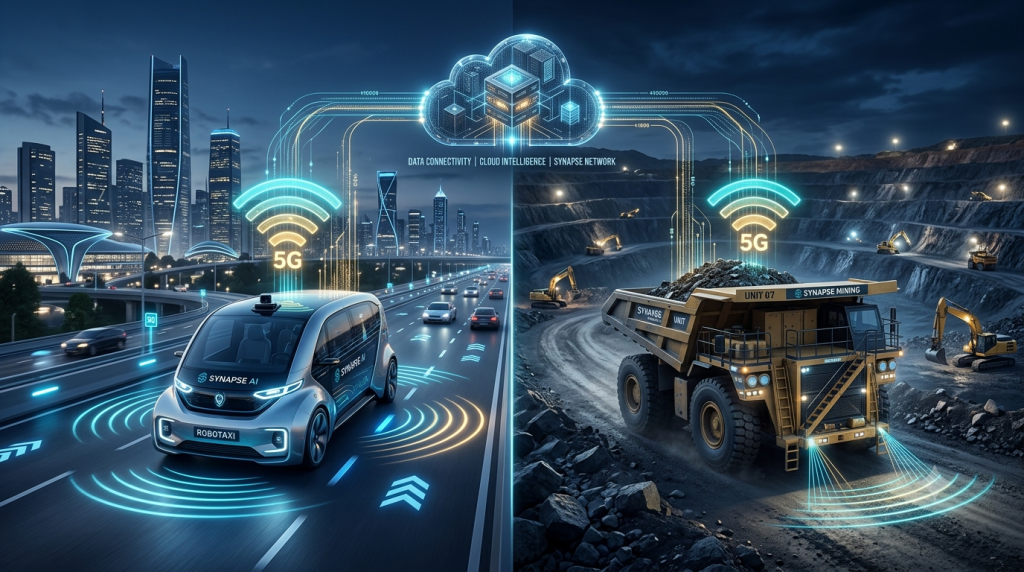 I. Introduction: Bandwidth Explosion and High-Reliability Reshaping of Autonomous Driving Communication Architecture
In the real-world deployment of Robotaxis, autonomous mining trucks, and smart ports, the most critical bottleneck of high-level autonomous driving systems often lies not in the computing power of autonomous driving domain controllers, but in “the real-time capability of data transmission and the absolute continuity of communication links.”
As autonomous driving evolves toward L4/L5 levels, in-vehicle communication architecture faces disruptive challenges:
· Geometric explosion in data throughput: Multiple high-definition cameras and high-channel LiDAR sensors generate gigabytes of data per second. Streaming video back to Remote Operation Centers (TOC) and uploading raw point clouds to the cloud can instantly overwhelm traditional 4G pipelines.
· Zero fault tolerance for communication links: In open-pit mining areas or under urban elevated highways, momentary network jitter or packet loss can trigger remote control disconnection or even emergency vehicle braking.
· Stringent time alignment for sensor fusion: Multi-sensor fusion computing heavily relies on global timestamps. If communication devices fail to provide hardware-level time synchronization, time-sequence misalignment and point-cloud ghosting occur.
Clarifying technical boundaries: Perception and decision-making in autonomous driving are executed by autonomous driving domain controllers. However, whether a vehicle maintains connection in complex network environments and delivers high-throughput data to the cloud without loss depends entirely on the vehicle communication gateway.
Traditional vehicle T-Boxes are undergoing a thorough technical evolution—from simple ‘remote vehicle control and data reporting terminals’ to smart vehicle communication gateways that connect the autonomous driving domain, body domain, cloud platforms, and roadside V2X infrastructure.
II. Architectural Reconstruction of Vehicle T-Box: From Telematics to Smart Communication Gateways
1. Definition and Engineering Limitations of Traditional T-Box
Traditional vehicle T-Boxes (Telematics Boxes) were originally designed to serve remote maintenance for internal combustion engine vehicles and conventional EVs. Their basic technical architecture revolves around:
· Data Pathways: Reading vehicle speed, battery state, and diagnostic trouble codes (DTCs) via CAN bus and OBD interfaces.
· Positioning and Transmission: Obtaining coordinates via GNSS modules and sending data to OEM clouds via 4G CAT1/CAT4 networks.
· Application Scenarios: Remote door locking/unlocking, remote HVAC control, anti-theft tracking, and basic infotainment OTA updates.
In standard passenger vehicle scenarios, this low-bandwidth, single-link architecture is sufficient. However, when faced with L4 autonomous driving, the limitations of traditional T-Boxes in communication bandwidth, bus speed, and network redundancy become acutely evident.
2. Next-Generation Communication Gateways for High-Level Autonomous Driving
To support the commercial deployment of driverless systems, next-generation vehicle communication gateways have achieved a comprehensive leap in hardware topology and communication protocols:
| [Traditional T-Box Architecture] Vehicle Low-Speed CAN Bus ──> Single 4G Module (Low Bandwidth / Single Link) ──> Basic Telematics Cloud[Smart Vehicle Communication Gateway Architecture] AD Domain Controller (Ethernet) ──┐ Cameras / LiDAR Sensors ──┼──> Dual 5G Heterogeneous Redundancy / GbE Automotive Ethernet ──> Remote Operation Center (TOC) Vehicle CAN-FD Network ──┤ Hardware-Level PTP/gPTP Time Sync ──> V2X / Cloud Scheduling Industrial PLC / Sensors ──┘ |
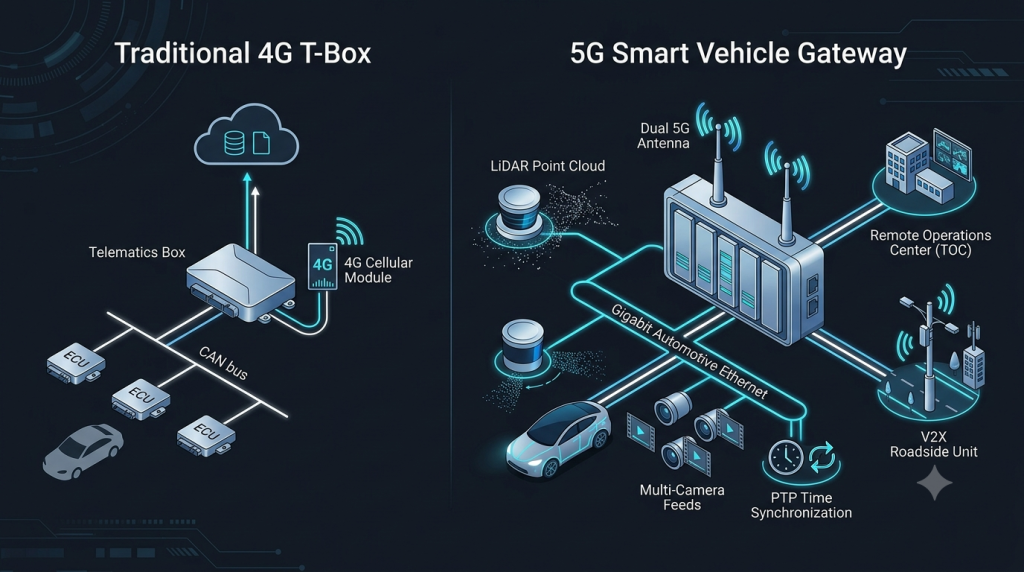
Compared with traditional T-Boxes, the core breakthroughs of smart communication gateways include:
1. Link Redundancy Capability: Integrating dual 5G/multi-module architectures with millisecond-level dynamic hot-standby and seamless failover.
2. Backbone Network Convergence: Deeply integrating CAN-FD and Gigabit Automotive Ethernet to serve as the high-speed data hub inside the vehicle.
3. Edge Processing and Precise Time Alignment: Built-in hardware-level protocol stacks (such as IEEE 1588 PTP) providing nanosecond-to-microsecond time baselines for multi-sensor fusion.
III. Three Major Engineering Pain Points and Selection Criteria in Autonomous Driving Wireless Communication
Conventional automotive-grade T-Boxes cannot be directly applied to Robotaxis or autonomous mining trucks because complex field deployment involves the following severe pain points:
Pain Point 1: The ‘Disconnection Nightmare’ under Complex Working Conditions
When Robotaxis pass through underground tunnels, elevated highways, or dense urban building clusters, frequent base station handovers easily cause data link drops. In industrial sites like open-pit coal mines, heavy dust blockage and complex terrain shielding cause severe signal attenuation.
· Key Selection Criterion: The gateway must feature dual 5G heterogeneous dual-standby (e.g., AT&T + Verizon or China Mobile + China Telecom) and intelligent link switching algorithms. During momentary main link degradation or packet loss, the gateway seamlessly stitches data flows to ensure uninterrupted remote control video streams and control commands.
Pain Point 2: Multi-Sensor Fusion and Time Jitter
If perception data from LiDAR, cameras, and millimeter-wave radar lack a unified time baseline, images spliced by the cloud or autonomous driving systems during high-speed travel or severe vibration will produce ‘ghosting’ or depth deviations, triggering false braking or missed detections.
· Key Selection Criterion: The gateway must support IEEE 1588v2 PTP / IEEE 802.1AS gPTP hardware-level time synchronization protocols, locking the time difference across all vehicle network nodes to microsecond (μs) or even nanosecond levels, rather than relying on software sync.
Pain Point 3: Long-Term Stability in Harsh Industrial Environments
Autonomous mining trucks and unmanned sweeping vehicles operate 24/7, facing extreme cold (-40°C), high heat (+75°C), continuous high-frequency mechanical vibration, and electromagnetic interference.
· Key Selection Criterion: The gateway must possess industrial-grade wide-temperature operation capabilities, comply with stringent anti-vibration/shock standards (such as ISO 16750), and feature high-level IP protection.
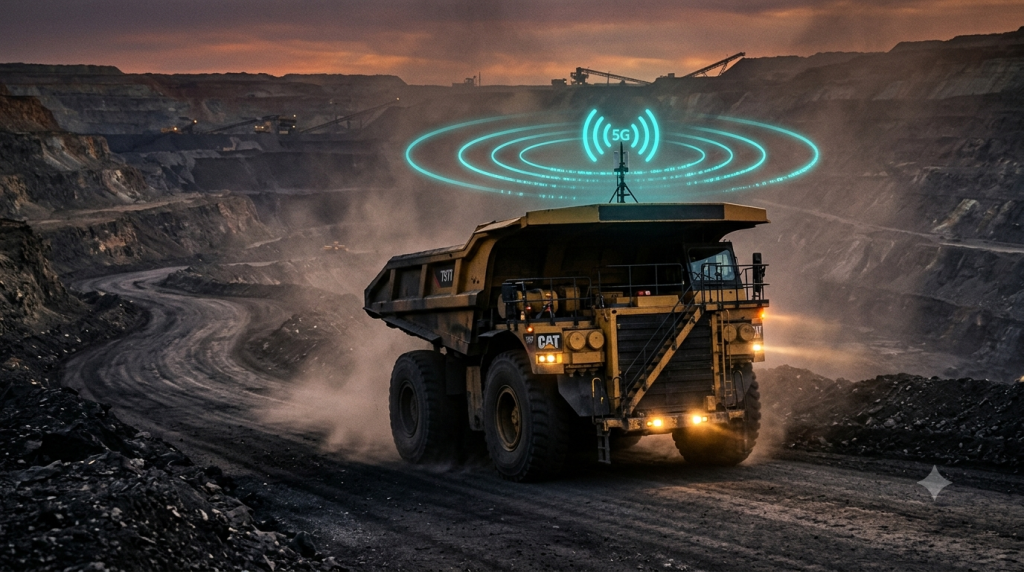
IV. Key-IoT SV910: Dual 5G Vehicle Gateway Solution Engineered for Driverless Evolution
To address the strict communication reliability demands of high-level scenarios such as Robotaxis, autonomous mining trucks, and smart ports, Key-IoT has developed the SV910 Dual 5G Industrial Vehicle Gateway, providing a loss-free transmission pipeline for vehicle-road-cloud synergy through a rugged hardware architecture.
1. Dual 5G Heterogeneous Redundancy: Eliminating Disconnection Risks in Complex Environments
The SV910 utilizes a dual 5G communication module design, supporting dual-SIM dual-standby and heterogeneous network deployment.
· Millisecond Seamless Failover: Built-in intelligent link detection algorithms monitor RSRP, SINR, and network latency in real time. Upon packet loss or jitter on the primary link, the system executes hot-standby failover within milliseconds.
· Heterogeneous Network Deployment: Supports cross-carrier configurations (e.g., China Mobile + China Unicom / AT&T + Verizon) to effectively bypass single-carrier blind spots and ensure high-quality transmission of TOC commands and real-time video streams.
2. High-Density Vehicle Interfaces: Breaking Data Silos
Autonomous driving systems contain numerous heterogeneous devices. The SV910 provides a rich interface expansion matrix:
· High-Speed Backbone Interfaces: Equipped with Gigabit Ethernet ports to perfectly match the high-bandwidth requirements of autonomous driving domain controllers and automotive Ethernet switches.
· Industrial Bus Compatibility: Integrates multiple CAN / CAN-FD channels, seamlessly interfacing with body control systems and industrial PLCs for high-frequency telemetry collection and control command dispatch.
· Serial & Expansion Ports: Provides RS232/RS485 serial ports to connect auxiliary equipment, positioning modules, and specialized industrial sensors.
3. Hardware-Level PTP/gPTP Time Synchronization Engine
The SV910 integrates a dedicated hardware time sync chip, fully supporting IEEE 1588v2 PTP and IEEE 802.1AS gPTP protocols.
· Master Clock Docking: Operating as a Master Clock or high-precision node within the in-vehicle network, the SV910 supplies a unified, high-precision clock source directly to LiDARs, cameras, and computing platforms.
· Precise Timing Assurance: Eliminates system overhead and cumulative jitter associated with software sync, ensuring strict spatial and temporal alignment of perception data.
4. Rugged Industrial-Grade Design: Built for Extreme Environments
· Wide Voltage & Wide Temperature: Supports 9–36V DC wide-voltage power input and -40°C to +75°C wide-temperature operation, adapting to various specialized vehicles and harsh industrial power grids.
· Anti-Vibration & Surge Protection: Metallic enclosure provides superior heat dissipation and EMC protection, certified to withstand severe mechanical shocks and continuous vibration.
V. Future Trends in Vehicle T-Box and Communication Gateways
Looking ahead, vehicle communication devices will further evolve alongside transformations in automotive Electronic/Electrical (E/E) Architecture:
1. Convergence with Centralized Computing and Zonal Architecture: Communication gateways will gradually transition from standalone devices into integrated functional modules within Zonal Controllers, deeply fusing with body domain controls.
2. Deep Synergy with C-V2X Vehicle-Road Infrastructure: Deep integration of 5G and C-V2X will become standard. Gateways will not only manage vehicle-to-cloud (V2C) communication but also execute direct vehicle-to-infrastructure (V2I) and vehicle-to-vehicle (V2V) safety alerts within milliseconds.
3. Software-Defined Gateways (SDG) and Edge Computing Downreach: Future gateways will host more edge computing tasks—such as data cleaning, anonymization, protocol translation, and local traffic routing—to relieve bandwidth pressure on cloud infrastructure.
In the era of commercial scaling and routine operations for autonomous driving, vehicle communication devices are no longer simple ‘connectivity accessories’; they are critical infrastructure directly impacting vehicle operational safety and data vitality.
For autonomous driving solution providers, mining automation operators, and mobility service platforms, selecting a vehicle gateway equipped with dual-5G redundancy, hardware-level time synchronization, and industrial-grade reliability is essential to building a zero-disconnection, high-throughput vehicle-road-cloud synergistic ecosystem. Key-IoT continues to advance industrial vehicle networking technologies, delivering rock-solid communication foundations for Robotaxis, autonomous mining trucks, and unmanned sweepers through robust solutions like the SV910.
Enter the result
Verification failed
 English English
  Español de Perú
 Русский
 العربية
 日本語
日本語
 简体中文
简体中文
 Français
 Deutsch
 繁體中文
繁體中文