 KEY-IOT

Dual 5G Vehicle Gateway for Autonomous Vehicles: Architecture and Network Redundancy
БЛОГ 159
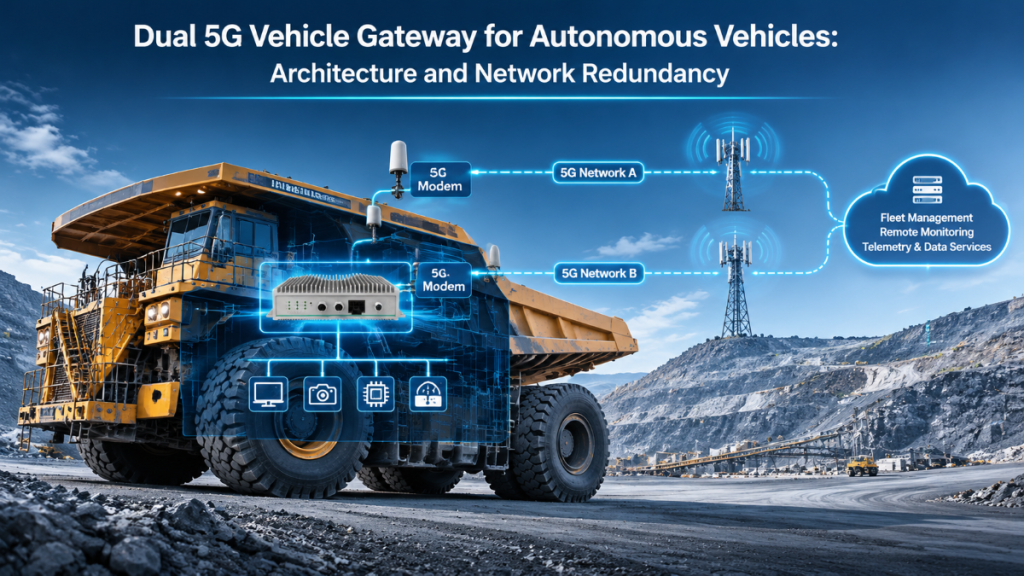
A vehicle with two SIM cards does not necessarily have two independent cellular connections. Nor does a gateway with two 5G modems automatically provide seamless failover or double network bandwidth.
These distinctions matter when designing communication systems for autonomous vehicles. A mining truck operating across a large open-pit site, for example, may need to maintain communication with fleet management and remote monitoring platforms even when one cellular connection becomes unavailable. A second modem can provide another network path, but the gateway must also manage that path correctly.
A Dual 5G Vehicle Gateway integrates two 5G cellular modem modules into a vehicle communication platform. Depending on its hardware, firmware, carrier configuration, and network management capabilities, it can support simultaneous cellular connections, alternative network paths, and different traffic management strategies.
The engineering challenge is not simply adding a second modem. It is designing a communication architecture that can use multiple cellular connections effectively and recover from network failures without making unsupported assumptions about availability or performance.
This guide examines dual SIM and dual modem architectures, dual 5G network design, Active-Standby and Active-Active operation, cellular failover, and vehicle gateway selection. It also compares KEY-IOT’s SV910 and SV900 vehicle gateway solutions for autonomous and industrial vehicles.
1. Why Autonomous Vehicles Need Cellular Network Redundancy
1.1 Vehicle-to-Cloud Communication in Autonomous Fleets
Autonomous vehicles perform their primary perception, planning, and driving-control tasks through onboard computing systems. Cellular connectivity serves a different purpose: connecting the vehicle to external operational infrastructure.
Typical vehicle-to-cloud communication includes:
Fleet management: Vehicle location, operating status, task assignments, and fleet coordination.
Remote monitoring: Telemetry, system health information, diagnostic data, and operational alerts.
Remote assistance: Communication between vehicles and authorized remote operators.
Operational data transfer: Uploading selected sensor data, logs, and vehicle records.
Remote maintenance: Device configuration, software management, and diagnostic access.
These applications do not all have the same network requirements. Periodic telemetry may use relatively little bandwidth, while selected camera streams or diagnostic files can require substantially more.
A vehicle communication gateway connects onboard equipment to external networks. It may integrate Ethernet, CAN, serial, and other vehicle interfaces with cellular connectivity, allowing data to move between the vehicle network and remote platforms.
The gateway is therefore part of the vehicle’s communication architecture, not simply an internet access device.
1.2 Why a Single Cellular Connection Can Be a Weak Point
A single cellular modem provides one primary wireless access path. If that connection is lost, communication with external services may be interrupted until the connection recovers or another path becomes available.
Mobile environments introduce several challenges:
Changing radio conditions: Vehicle movement, terrain, buildings, industrial structures, and distance from base stations can affect signal quality.
Coverage gaps: Open-pit mines, tunnels, remote roads, and large industrial facilities may contain areas with limited cellular coverage.
Network congestion: A strong radio signal does not guarantee consistent throughput or low latency when network resources are heavily utilized.
Carrier availability: Different mobile operators have different coverage footprints, frequency bands, and network infrastructure.
Network handovers: As a vehicle moves between cells, the cellular network manages radio handovers. These procedures do not eliminate every possible interruption or application-level communication problem.
For a fleet operating across a large area, a second cellular connection can provide another communication option when the primary path becomes unsuitable.
The value of that second connection depends on whether it is genuinely available and whether the gateway can use it when needed.
1.3 What Network Redundancy Actually Requires
Adding a second SIM card or modem is only one part of a redundancy design.
An effective arrangement also needs to consider:
Whether both cellular connections can operate simultaneously.
Whether they use different mobile network operators.
Whether the secondary connection is already established or must reconnect after failure.
How the gateway detects an unavailable connection.
How traffic is redirected to an alternative path.
Whether applications can recover when the network path changes.
Two cellular subscriptions may still depend on shared infrastructure. Two active modems may also share the same gateway processor, power supply, or antenna installation.
For this reason, engineers should evaluate redundancy across the complete communication system rather than treating modem count as a measure of reliability.
2. Dual SIM vs. Dual Modem: Understanding the Hardware Architecture
2.1 What Is a Dual 5G Vehicle Gateway?
A Dual 5G Vehicle Gateway contains two 5G cellular modem modules within one gateway platform.
Each modem provides a separate cellular radio resource. When the device and network configuration support simultaneous operation, the two modems can establish separate cellular connections.
A simplified architecture is:
Vehicle Equipment → Vehicle Gateway → Cellular Modem 1 / Cellular Modem 2 → Mobile Networks → Remote Platform
The gateway manages the vehicle-side interfaces and the available network paths. Its routing and network management functions determine how traffic uses those connections.
Depending on the implementation, the two cellular paths may be used for:
Primary and backup connectivity.
Traffic distribution across available connections.
Different applications or traffic classes.
Alternative network access when one connection becomes unavailable.
The presence of two modems does not, by itself, determine which of these functions a product supports.
2.2 Dual SIM, DSDS, DSDA, and Dual Modem
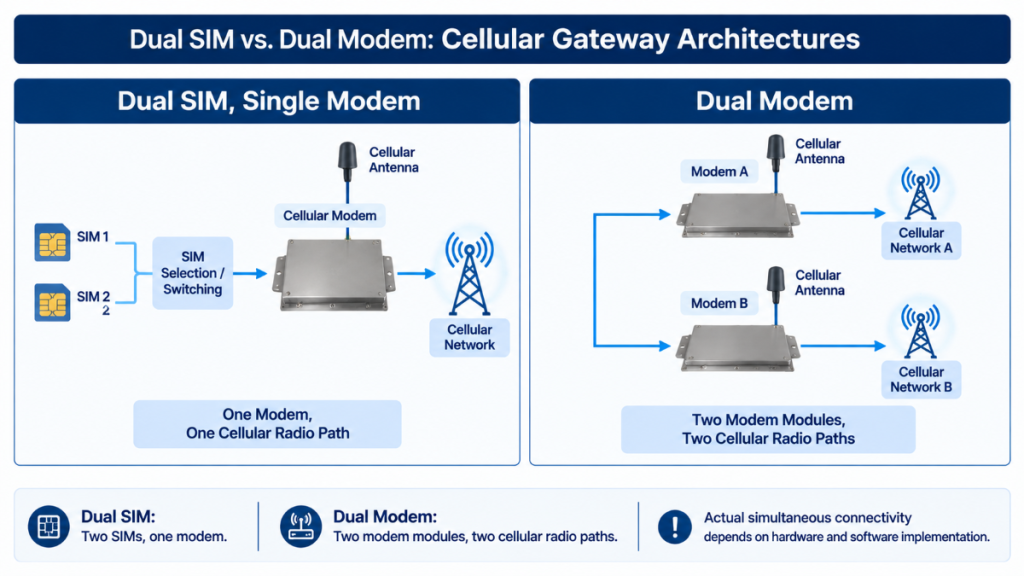
These terms describe different aspects of cellular hardware and operation. They should not be treated as interchangeable.
| Term | Meaning | What It Tells You |
| Dual SIM | Two SIM interfaces or supported subscriptions | The device can accommodate two SIMs |
| DSDS | Dual SIM Dual Standby | Two SIMs can remain on standby, subject to radio-resource limitations |
| DSDA | Dual SIM Dual Active | Two SIM subscriptions can maintain active communication under the supported implementation |
| Dual Modem | Two cellular modem modules | The device has two separate modem resources |
Dual SIM describes SIM capability, not the number of cellular modem modules.
A single-modem device may support two SIM cards and switch between them. Depending on its design, it may use one subscription for the active cellular connection while the other remains on standby.
DSDS (Dual SIM Dual Standby) allows two SIM subscriptions to remain registered or available for standby, but the device’s radio architecture can limit simultaneous active communication. The exact behavior depends on the modem and platform implementation.
DSDA (Dual SIM Dual Active) supports active communication through both SIM subscriptions under the relevant implementation. However, the term alone does not establish that the device has two independent 5G data paths or two separate modem modules. Product documentation must clarify the actual architecture.
Dual Modem describes the hardware more directly: two cellular modem modules are installed. This provides two separate modem resources and can support two simultaneous cellular connections when the hardware, firmware, and network configuration allow it.
The practical distinction is straightforward: SIM count, standby behavior, simultaneous communication, and modem count are separate characteristics.
Before selecting a gateway, verify the following:
How many physical modem modules are installed?
Can both modems establish cellular connections simultaneously?
How are SIM cards or eSIM profiles assigned to each modem?
Can the two modems connect to different operators?
Which network management and backup functions are supported?
A product description that says “dual SIM” is not sufficient evidence of a dual-modem architecture.
2.3 Dual 5G vs. 5G + 4G/RedCap
Dual 5G and 5G + 4G/RedCap are different modem configurations.
Dual 5G uses two 5G-capable modem modules. It is suitable when both cellular paths need 5G capability, provided that the selected modules, SIM subscriptions, and mobile networks support the required bands and services.
5G + 4G combines a 5G modem with an LTE modem. This may be appropriate when the secondary connection is intended for backup traffic and LTE coverage is sufficient for that purpose.
5G + RedCap combines a full-capability 5G connection with a 5G RedCap-capable module, where supported by the product configuration.
RedCap, short for Reduced Capability, is part of the 5G NR technology family. It is designed for devices that do not require the full capabilities of higher-performance 5G equipment. It should not be treated as a separate generation of cellular technology alongside 5G.
| Конфигурация | Cellular Technology | Selection Consideration |
| Dual 5G | Two 5G NR modem modules | Both connections require 5G capability |
| 5G + 4G | One 5G NR and one LTE modem | LTE may be sufficient for secondary connectivity |
| 5G + RedCap | Full-capability 5G and 5G RedCap | Appropriate when the secondary link’s requirements match RedCap capabilities |
The right configuration depends on coverage, throughput requirements, latency, power consumption, module availability, and cost.
For example, a vehicle that needs high-capacity connectivity through both paths may justify Dual 5G. If the secondary path only needs to support status reporting and basic operational communication, a 5G + 4G or 5G + RedCap configuration may be more practical.
The modem combination should be confirmed against the exact product variant. A general product-family description does not establish that every model supports every configuration.
3. Dual 5G Network Architecture for Autonomous Vehicles
3.1 Two Modems Do Not Automatically Mean Two Independent Networks
A dual-modem gateway can establish two cellular connections, but the degree of network independence depends on how those connections are deployed.
Consider a vehicle using two SIM subscriptions from different mobile network operators. This may improve network diversity, but it does not guarantee that the connections have completely independent infrastructure.
Both operators may rely on shared:
Physical sites or tower infrastructure.
Backhaul providers.
Power infrastructure.
Core network or interconnection resources.
Geographic coverage areas.
A failure in shared infrastructure may affect both connections.
Engineers should therefore distinguish between subscription diversity и infrastructure diversity.
Subscription diversity means using different operators or network subscriptions. Infrastructure diversity requires evaluating the actual network resources and failure dependencies behind those subscriptions.
For a mining site or industrial park, network planning should consider the location of base stations, coverage overlap, backhaul paths, and the vehicle’s operating routes.
3.2 Active-Standby Architecture
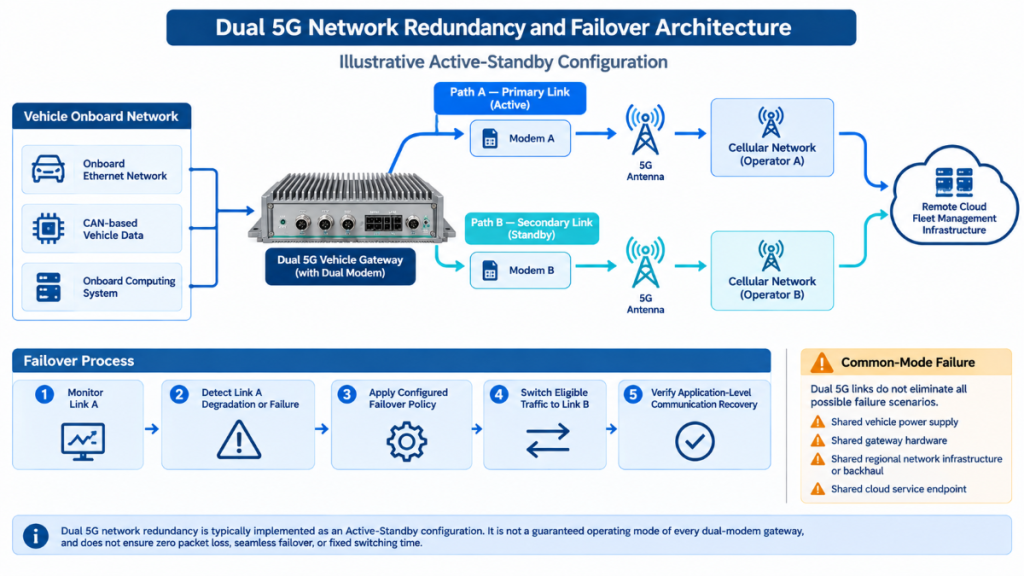
In an Active-Standby arrangement, one cellular connection carries normal traffic while another is available as an alternative path.
A typical configuration is:
Modem 1: Primary cellular connection.
Modem 2: Secondary or backup connection.
Gateway: Monitors the configured network status and applies routing policies.
When the primary connection meets a configured failure condition, the gateway may redirect traffic to the secondary connection if the relevant backup functionality is supported.
The main advantage is a clearly defined primary path and an alternative path.
However, the actual recovery behavior depends on whether the backup modem is already connected, how the gateway detects failure, and how routes and application sessions are restored.
An Active-Standby design is often a practical starting point when the main requirement is an alternative communication path rather than distributing traffic across both connections.
3.3 Active-Active Architecture
In an Active-Active arrangement, both cellular connections are available for traffic at the same time.
The gateway may distribute different traffic flows between the connections according to routing rules, priorities, destinations, or application requirements.
For example, a vehicle could use one connection for routine fleet telemetry and another for selected data uploads, provided the gateway supports the required routing policies.
Active-Active can improve utilization of available network resources, but it introduces additional design considerations:
How traffic is assigned to each connection.
Whether routing is based on destination, application, or policy.
How traffic behaves when one path becomes unavailable.
Whether the remote platform can handle connections arriving through different network paths.
How existing sessions recover after a path change.
Active-Active does not automatically mean bandwidth aggregation.
Two connections may both carry traffic without combining their throughput into one logical connection. The distinction becomes important when an application expects a single session to use the capacity of both links.
3.4 Load Balancing vs. Bandwidth Bonding
These terms describe different network functions.
| Функция | Как это работает | Main Purpose |
| Active-Standby | One path carries normal traffic; another is available as backup | Alternative connectivity |
| Load Balancing | Different traffic flows are distributed across available paths | Use multiple connections |
| Policy-Based Routing | Traffic is directed according to configured rules | Control which path carries specific traffic |
| Bandwidth Bonding | Multiple links are coordinated as a logical communication path | Combine available link capacity under a supported design |
| Packet Duplication | Selected packets are transmitted over multiple paths | Improve delivery resilience for supported traffic |
Load balancing does not necessarily combine bandwidth for a single application session. It may simply distribute separate connections across different WAN interfaces.
Bandwidth bonding requires additional mechanisms, often involving tunneling or coordinated processing at both ends of the connection. The achievable throughput depends on link conditions, bonding implementation, and endpoint support.
Packet duplication is another distinct mechanism. It sends duplicate traffic over multiple paths so that a receiver can use an available copy. This requires explicit support and should not be assumed from a dual-modem configuration.
These distinctions matter when comparing gateway specifications. Terms such as “dual link,” “load balancing,” “aggregation,” and “redundancy” should be supported by specific descriptions of how the device handles traffic.
3.5 Vehicle-to-Cloud Communication Through Dual 5G
A dual 5G gateway sits between the vehicle’s onboard communication network and external cellular infrastructure.
A typical system contains four layers:
- Vehicle-side equipment
Onboard computers, vehicle controllers, Ethernet devices, and other equipment generate operational data.
- Автомобильный шлюз
The gateway connects vehicle interfaces to external networks and manages the available cellular connections.
- Cellular access
Two modem modules establish cellular connections according to the selected configuration and network availability.
- Remote infrastructure
Fleet management platforms, monitoring systems, remote service infrastructure, and cloud applications receive vehicle data.
Traffic should be managed according to its actual requirements. Periodic telemetry, diagnostic uploads, remote assistance, and selected sensor data may need different routing, bandwidth, and recovery policies.
The gateway can support communication between these systems, but cellular connectivity should not be treated as a substitute for onboard safety functions. Autonomous driving decisions and safety-critical control must remain appropriately supported by the vehicle’s local systems.
4. Cellular Network Redundancy and Automatic Failover
4.1 How Automatic Failover Works
Failover is the process of moving traffic from an unavailable or unsuitable network path to an alternative path.
A typical cellular failover process involves five stages.
Stage 1: Establish network connections
The gateway establishes the primary cellular connection and, where configured, makes a secondary connection available.
Stage 2: Monitor connectivity
The gateway monitors the status of the relevant network interfaces or remote connectivity targets.
Stage 3: Detect a failure
A failure condition may be identified through modem status, network registration, interface status, gateway reachability, or an end-to-end connectivity test.
Stage 4: Select an alternative path
The gateway applies its routing or backup policy to move traffic to an available connection.
Stage 5: Recover normal communication
Traffic resumes through the selected path. Depending on the network and application, existing sessions may need to reconnect.
This is a general network design process, not a description of a specific product’s guaranteed switching behavior. Actual failover functions must be verified against the gateway’s hardware, firmware, and supported configuration.
4.2 Link Monitoring: Modem Status Is Not Enough
A cellular modem can remain registered to a mobile network even when a remote server or internet destination is unreachable.
For this reason, checking only whether a modem is connected does not always provide enough information to determine whether the application can communicate.
Different monitoring methods check different layers:
| Monitoring Method | What It Checks | Limitation |
| Modem status | Whether the modem is operating | Does not prove network access |
| Network registration | Whether the modem is registered to a cellular network | Does not prove remote service reachability |
| Interface status | Whether the network interface is available | Does not prove end-to-end communication |
| Gateway reachability | Whether a configured gateway responds | Does not prove the application server is reachable |
| End-to-end probe | Whether a selected remote endpoint responds | Does not guarantee all application services are available |
A more comprehensive design may combine several checks.
For example, a gateway may monitor both cellular registration and the reachability of a remote endpoint. This can help distinguish a radio or modem problem from an upstream network issue.
The correct monitoring method depends on the application and network topology.
4.3 Failover Time and Application Recovery
There is no universal failover time for a dual 5G gateway.
The time required to restore communication depends on several stages:
Failure detection interval.
Number of failed checks required to confirm an outage.
Availability of the secondary cellular connection.
Route or policy update time.
VPN tunnel recovery, where applicable.
Application reconnection behavior.
It is useful to distinguish three measurements:
Failure Detection Time
How long the gateway takes to identify that the primary path is no longer usable.
Traffic Recovery Time
How long it takes for traffic to resume through the alternative path.
Application Recovery Time
How long the remote application takes to restore normal communication.
These values may differ significantly.
A gateway can redirect new traffic to another connection while an existing TCP session or VPN tunnel still requires recovery. A change in public IP address, NAT mapping, route, or tunnel endpoint can affect application sessions.
For projects with specific availability requirements, engineers should test these stages separately.
Testing should include loss of cellular registration, upstream connectivity failure, poor signal conditions, recovery of the primary connection, and switching between operators.
4.4 Failback and Connection Recovery
Failover is only part of network recovery. Engineers must also consider what happens after the original connection becomes available again.
A gateway may be configured to:
Continue using the secondary connection.
Return to the preferred primary connection automatically.
Wait until the primary connection remains stable for a configured period.
Require a specific recovery condition before switching back.
These behaviors are commonly described as failback or recovery policies.
The choice affects network stability. If a primary connection repeatedly becomes available and unavailable, aggressive switching can cause repeated route changes and application interruptions.
A well-designed policy should account for link stability, recovery thresholds, and application requirements.
The actual behavior must be verified for the selected gateway and software configuration.
4.5 Common-Mode Failures: Why Two Connections May Fail Together
A dual-modem design reduces dependence on a single cellular path, but both paths may still share failure points.
Consider the following examples:
Shared coverage conditions
Both modems may experience poor signal in the same tunnel, mine area, or industrial building.
Shared network infrastructure
Different operators may use common backhaul providers, sites, or power infrastructure.
Shared vehicle hardware
Both modems may depend on the same gateway processor, power supply, or internal communication subsystem.
Shared antenna installation
Poor antenna placement, cable damage, or inadequate isolation may affect both connections.
Shared remote infrastructure
Both connections may reach the same remote server, VPN concentrator, or cloud service. If that destination is unavailable, changing cellular paths will not restore the service.
This is known as a common-mode failure problem: multiple apparently separate paths are affected by the same underlying cause.
For critical deployments, network redundancy should be planned across cellular operators, coverage areas, vehicle hardware, and remote infrastructure.
5. Dual 5G Connectivity in Autonomous Vehicle Applications
5.1 Autonomous Mining Trucks
Autonomous mining trucks operate across large sites where vehicle communication is part of the wider fleet management system.
A vehicle gateway may support:
Vehicle status reporting.
Fleet management communication.
Remote monitoring and diagnostics.
Selected operational data transmission.
Remote maintenance connectivity.
Mining sites can have significant coverage variation because of terrain, excavation activity, equipment, and changing vehicle routes.
A dual 5G gateway can provide two cellular access paths, particularly where the site has been designed to support network diversity.
The most important engineering task is to validate coverage across actual operating routes. A second modem cannot compensate for an area where neither cellular network provides usable service.
5.2 Autonomous Logistics and Delivery Vehicles
Autonomous logistics and delivery vehicles may operate across warehouses, industrial parks, logistics centers, and public or semi-public roads.
Their communication requirements include fleet scheduling, location reporting, operational status, remote diagnostics, and selected data transmission.
A dual-modem gateway can provide alternative cellular connectivity and, where supported, distribute traffic across available network paths.
For fleets operating across different geographic areas, using more than one mobile operator may also help address differences in coverage.
5.3 Robotaxis and Robobuses
Robotaxis and autonomous buses use onboard systems for driving decisions, while cellular networks support communication with fleet platforms and remote service infrastructure.
Typical communication applications include:
Fleet status and vehicle location reporting.
Remote assistance communication.
Operational monitoring.
Maintenance and diagnostic data transmission.
Vehicle-to-cloud services.
A dual 5G gateway can provide additional network options for these applications.
However, external cellular connectivity should not be treated as a substitute for onboard autonomous driving safety systems. Vehicles must maintain appropriate local capabilities and safety procedures when external communication is unavailable.
5.4 Smart Ports and Unmanned Industrial Vehicles
Smart ports and industrial logistics facilities may operate autonomous container transporters, yard trucks, inspection vehicles, and other unmanned equipment.
A vehicle gateway can connect onboard systems to industrial communication infrastructure and remote management platforms.
Applications include fleet scheduling, equipment monitoring, operational data reporting, and remote diagnostics.
Engineers should first identify the site’s network architecture. Public cellular networks, private 5G infrastructure, and hybrid deployments have different requirements for SIM provisioning, network access, coverage planning, and gateway configuration.
6. How to Choose a Dual 5G Vehicle Gateway
A dual 5G gateway should be selected according to the vehicle’s communication architecture, not simply the number of cellular modem modules.
6.1 Verify the Modem Architecture
Start with the hardware.
Ask the manufacturer:
Does the gateway contain two independent cellular modem modules?
Can both modems establish simultaneous connections?
Which combinations of 5G, LTE, or RedCap are supported?
How are SIM cards and eSIM profiles assigned?
Can the connections use different mobile operators?
Are there different hardware variants with different modem configurations?
Do not infer modem count from the number of SIM slots. Request the exact hardware configuration for the product variant being purchased.
6.2 Check Regional Cellular Compatibility
A modem’s supported frequency bands must match the mobile operators and deployment region.
Verify:
5G NR bands.
LTE bands, where applicable.
Regional operator compatibility.
SIM subscription and provisioning requirements.
Roaming arrangements.
Private network compatibility, if required.
A product that supports 5G in one market may require a different module configuration in another.
6.3 Evaluate Network Management and Failover
Check what the gateway actually supports.
Relevant functions may include:
Cellular link monitoring.
WAN status detection.
Link backup.
Primary and secondary path configuration.
Policy-based routing.
Multi-WAN management.
Remote network status monitoring.
Recovery and failback policies.
If a project requires a specific recovery time, session continuity, or traffic distribution behavior, request technical documentation and validation results for the selected configuration.
Do not treat a general statement such as “dual 5G redundancy” as proof of a particular failover performance level.
6.4 Match Vehicle Interfaces
The gateway must connect to the equipment installed in the vehicle.
Depending on the architecture, relevant interfaces may include:
Automotive Ethernet, including 100BASE-T1 and 1000BASE-T1.
Standard Ethernet.
CAN or CAN FD, where explicitly supported.
RS232 and RS485.
Digital inputs and outputs.
Wi-Fi and GNSS interfaces.
Automotive Ethernet T1 and standard Ethernet TX interfaces have different physical-layer characteristics and connection requirements. Engineers should confirm the exact interface type rather than treating all Ethernet ports as interchangeable.
Also verify the number of interfaces, connector type, supported data rates, isolation, and software configuration options.
6.5 Plan the Antenna System
A dual-modem gateway needs an antenna system appropriate for its cellular configuration.
Check:
Number of cellular antenna ports.
Supported frequency ranges.
MIMO configuration.
Antenna gain and radiation characteristics.
Cable length and insertion loss.
Antenna separation and isolation.
Vehicle mounting location.
Environmental exposure.
Two modems do not guarantee good radio performance if the antennas are poorly installed.
Antenna placement should be validated on the actual vehicle, taking account of metal structures, other radio equipment, and the vehicle’s operating environment.
6.6 Verify Power and Environmental Requirements
Vehicle installations can expose gateways to power fluctuations, vibration, temperature variation, and electromagnetic interference.
Review:
Operating voltage range.
Power consumption under normal and peak conditions.
Reverse-polarity and overvoltage protection.
Operating temperature.
Connector retention.
Mechanical mounting.
Protection rating.
For mining, port, and outdoor industrial applications, these factors can be as important as the modem specification.
6.7 Consider Remote Management and Security
A fleet may contain dozens or hundreds of автомобильные шлюзы. Remote management can simplify maintenance and help operators monitor devices across different sites.
Relevant functions include:
Remote configuration.
Network status monitoring.
Traffic statistics.
System logs.
Firmware updates.
VPN connectivity.
Firewall and access control.
Device health reporting.
Security must be considered across the entire communication system. A VPN alone does not provide complete end-to-end security; authentication, access control, credential management, software maintenance, and cloud-side policies also matter.
7. KEY-IOT Dual 5G Vehicle Gateway Solutions
KEY-IOT develops vehicle communication gateways for connected and autonomous vehicle applications, including autonomous mining trucks, smart ports, logistics vehicles, and other mobile industrial equipment.
Its SV910 and SV900 product families offer configurable cellular solutions, including optional dual 5G and 5G + 4G/RedCap configurations. They address different vehicle integration requirements.
7.1 SV910: Dual 5G Automotive Ethernet Vehicle Gateway
Сайт KEY-IOT SV910 5G Vehicle Gateway combines cellular connectivity with automotive Ethernet and vehicle communication interfaces.
Its cellular configuration can be selected as dual 5G or 5G + 4G/RedCap, depending on the hardware configuration.
Key interfaces and capabilities include:
Optional dual 5G or 5G + 4G/RedCap cellular modules.
3 × 1000/100BASE-T1 interfaces.
3 × 100BASE-T1 interfaces.
2 × 1000/100BASE-TX interfaces with M12 connectors.
SIM/eSIM support.
2 × CAN interfaces, expandable to 3.
1 × RS232 and 1 × RS485.
2 × digital inputs and 2 × relay outputs.
DC 9–48V power input.
IEEE 802.1AS (gPTP) and hardware-based IEEE 1588v2 PTP support.
The SV910 also lists network management functions such as link detection and link backup, with supported combinations involving dual 5G, WAN, and Wi-Fi.
These functions are relevant when designing alternative communication paths. The specific detection, switching, and recovery behavior should be confirmed against the selected hardware and software configuration.
When should engineers consider the SV910?
The SV910 is particularly relevant when the vehicle architecture requires multiple automotive Ethernet interfaces alongside cellular connectivity.
Its combination of T1 and TX Ethernet interfaces allows it to be considered for vehicle networks that need both automotive Ethernet connectivity and external cellular communication.
For autonomous vehicle projects, this can simplify the communication architecture by integrating vehicle-side networking and cellular access into one gateway platform.
7.2 SV900: Configurable Dual 5G Vehicle Gateway
Сайт KEY-IOT SV900 5G Vehicle Gateway provides a configurable vehicle communication platform for applications requiring cellular connectivity and M12 vehicle connections.
Its listed hardware configurations include optional dual 5G and 5G + 4G/RedCap modem combinations. SIM/eSIM support is also available.
Other listed capabilities include:
M12 Ethernet connections.
Optional GPS/BeiDou.
Optional Wi-Fi 6.
Linux-based secondary development support.
Multi-link management functions, including link detection and link backup.
The SV900 product family includes different cellular hardware variants. Buyers should confirm the exact PID and modem configuration when specifying a dual 5G unit. The number of SIM interfaces should not be used as a substitute for verifying the actual modem architecture.
When should engineers consider the SV900?
The SV900 is worth evaluating when a project requires configurable cellular connectivity, M12 vehicle connections, and Linux secondary development.
Its suitability depends on the selected hardware variant and whether its available interfaces match the vehicle’s communication requirements.
For projects with specific Ethernet, CAN, or serial interface requirements, the exact current specification should be checked before selecting a configuration.
7.3 SV910 vs. SV900: Choosing the Right Vehicle Gateway
Both product families offer optional dual 5G configurations, but their selection should be based on vehicle-side networking and integration requirements.
| Selection Factor | SV910 | SV900 |
| Dual 5G | Optional configuration | Available in selected hardware variant |
| 5G + 4G/RedCap | Optional configuration | Available in selected hardware variant |
| Автомобильный Ethernet | Multiple T1 interfaces | Confirm exact interface configuration for selected version |
| Standard Ethernet | 2 × 1000/100BASE-TX with M12 | M12 Ethernet; confirm selected version |
| CAN | 2 interfaces, expandable to 3 | Confirm selected hardware configuration |
| Serial interfaces | RS232 and RS485 | Confirm selected hardware configuration |
| SIM/eSIM | Поддерживается | Поддерживается |
| Link management | Link detection and backup | Link detection and backup |
| Development flexibility | Depends on software configuration | Linux secondary development support |
Выбирайте SV910, если:
The vehicle requires multiple automotive Ethernet T1 interfaces.
The gateway needs to connect automotive Ethernet equipment and external cellular networks.
IEEE 802.1AS (gPTP) or hardware-based IEEE 1588v2 PTP support is required.
Vehicle-side Ethernet integration is a major selection factor.
Consider the SV900 when:
The project requires a configurable dual 5G or 5G + 4G/RedCap gateway.
M12 vehicle connections are required.
Linux secondary development is important.
The selected hardware variant provides the required vehicle interfaces.
Neither model should be selected solely because it supports two cellular modem modules. The final decision should account for the modem configuration, interface requirements, software functions, installation conditions, and validated network behavior.
For deployment-specific recommendations, engineers can contact KEY-IOT with their vehicle model, cellular network requirements, and intended operating environment.
8. Frequently Asked Questions
What is the difference between Dual SIM and Dual Modem?
Dual SIM refers to two SIM interfaces or subscriptions. Dual Modem means the device contains two cellular modem modules. A dual-SIM device may use one active modem connection at a time, while a dual-modem architecture can support two simultaneous cellular connections when the hardware and software allow it.
What is DSDS vs. DSDA?
DSDS stands for Dual SIM Dual Standby. Two SIM subscriptions can remain on standby, subject to the device’s radio-resource limitations. DSDA stands for Dual SIM Dual Active and supports active communication through both subscriptions under the relevant implementation. Neither term alone proves that a device has two independent 5G modem modules.
Can two 5G modems connect to different mobile network operators?
Yes, if both modem modules, SIM subscriptions, supported frequency bands, and network configurations allow it. Using different operators can improve network diversity, but it does not guarantee complete infrastructure independence.
Does a Dual 5G Vehicle Gateway provide automatic failover?
Not automatically. Two modems provide the hardware foundation for multiple cellular connections. Automatic failover also requires link monitoring, failure detection, routing policies, and recovery mechanisms. The actual behavior must be confirmed for the selected product and configuration.
Does Dual 5G double network bandwidth?
No. Two active cellular connections do not automatically combine into one connection with twice the bandwidth. Load balancing can distribute different traffic flows, while bandwidth bonding requires additional mechanisms and compatible endpoint support.
What is the difference between load balancing and bandwidth bonding?
Load balancing distributes traffic across available network paths, often by assigning different connections or flows to different WAN interfaces. Bandwidth bonding coordinates multiple paths as a logical connection and may combine their available capacity under a supported architecture. The two functions are not interchangeable.
Is Dual 5G better than 5G + 4G for autonomous vehicles?
It depends on the deployment. Dual 5G may be appropriate when both connections require 5G capability. A 5G + 4G configuration may be sufficient when LTE coverage is available and the secondary connection only needs to support lower-bandwidth backup traffic. Coverage, performance, cost, and application requirements should determine the choice.
Does a dual-modem gateway need separate antennas for each modem?
The antenna configuration depends on the modem modules, supported MIMO arrangement, and gateway design. Engineers should check the manufacturer’s antenna-port requirements and validate antenna placement, isolation, and cable losses on the vehicle. The presence of two modems does not establish a particular antenna configuration.
9. Conclusion
A Dual 5G Vehicle Gateway provides two cellular modem resources within one vehicle communication platform. It can support multiple cellular connections and give engineers more options for network redundancy, traffic management, and vehicle-to-cloud connectivity.
But modem count alone does not determine network resilience. The actual result depends on carrier diversity, coverage, link monitoring, routing policies, failover and failback behavior, antenna installation, and application-level recovery.
When selecting a gateway, engineers should distinguish dual SIM from dual modem architecture, understand the difference between load balancing and bandwidth bonding, and verify the network management functions supported by the exact hardware configuration.
KEY-IOT’s SV910 and SV900 offer configurable dual 5G vehicle gateway options for different integration requirements. The SV910 is particularly relevant to applications requiring multiple automotive Ethernet interfaces, while the SV900 provides a configurable vehicle gateway platform with M12 connections and Linux secondary development support.
The right choice depends on the vehicle’s communication architecture, the required cellular configuration, and the operating environment. A well-designed dual 5G deployment begins with those requirements—not simply with the number of modems installed.
Author: Neo Cheng — Content Lead at Key-IoT, responsible for technical content strategy and editorial development covering automotive Ethernet, vehicle communication gateways, in-vehicle network integration, and connectivity solutions for autonomous vehicles.
Technical Review: Key-IOT Automotive Connectivity Engineering Team — responsible for reviewing technical concepts, network architecture, product specifications, and engineering application details.
 English
 Español de Perú
 Русский
 العربية
 日本語
 简体中文
 Français
 Deutsch
 繁體中文