 KEY-IOT
ПОИСК
- 葡萄酒 | 威士忌 | 白兰地 | 啤酒 -.
- 葡萄酒 | 威士忌 | 白兰地 | 啤酒 -.
As urban Robobuses, unmanned mining trucks, and industrial park delivery robots gradually become a reality, autonomous driving is no longer a concept confined to the laboratory, but is reshaping the underlying logic of transportation and logistics. However, behind large-scale deployment, four major bottlenecks —perception, decision-making, communication, and collaboration —still determine the safety boundaries of intelligent driving systems.
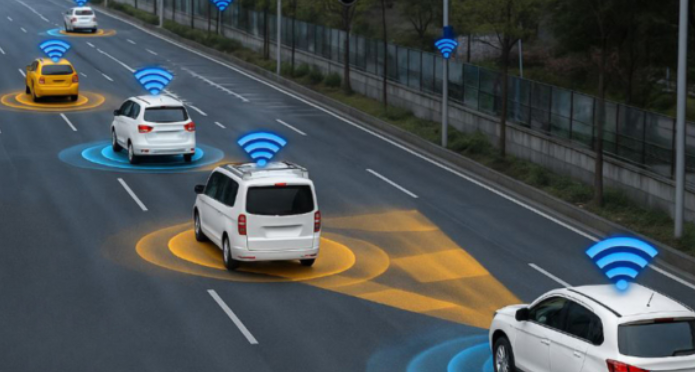
Truly mature autonomous driving is not just about “seeing and avoiding obstacles,” but also about being able to connect, remain stable, and coordinate effectively .
Even the most advanced intelligent vehicles have limitations such as blind spots, failure in extreme weather, and location drift. Complex scenarios such as tunnels, elevated roads, canyons between buildings, and mining areas can cause vehicles to become “blind” or inaccurate at any time; misalignment of multiple sensors, data transmission delays, and network interruptions can all directly threaten driving safety.
The core breakthrough of the next generation of advanced intelligent driving lies in its capabilities for direct vehicle-to-vehicle communication, vehicle-to-infrastructure (V2I) collaboration, and redundant communication across the entire domain . Vehicles are no longer solitary entities, but intelligent nodes capable of real-time “dialogue,” sharing road conditions, collaborative obstacle avoidance, and platooning. Direct communication, which is independent of base stations, has low latency, and high reliability, allows intelligent driving systems to upgrade from “passive reaction” to “active prediction,” and evolve from “single-vehicle intelligence” to “full-domain collaboration.”
From Level 4 autonomous driving to advanced driver assistance systems, from open roads to closed parks, stable, low-latency, high-precision, and highly redundant in-vehicle communication platforms are becoming the “last line of defense” for intelligent driving safety. Technologies such as dual 5G redundancy, in-vehicle Ethernet, nanosecond-level time synchronization, and V2X direct communication ensure that vehicles can achieve the following under any operating conditions: no data loss, no time sequence disruption, uninterrupted connection, and no decision-making delay.
The ultimate competition in autonomous driving is no longer about piling on sensors and competing on computing power, but about who is more stable, more reliable, and who can maintain the bottom line of safety in extreme scenarios . When collaborative intelligent driving becomes the industry consensus, a truly industrial-grade, automotive-grade, and fully redundant in-vehicle communication solution is the “core trump card” for the mass production and deployment of intelligent driving.
In the future, safety in travel will not be accidental, but rather reliable throughout the entire journey.
the Xingchuang Yilian V910 deeply integrates core capabilities such as 5G, V2X, low power consumption, TSN time-sensitive network, and high-precision positioning. This highly integrated system provides a highly reliable, low-latency, nanosecond-level synchronization, and low-power all-domain communication and data processing hub for L4 and above autonomous driving, facilitating the rapid commercial deployment of unmanned mining trucks, unmanned sweeping vehicles, unmanned shuttle buses, Robotaxi/bus, unmanned delivery vehicles, and unmanned container trucks.
Enter the result
Verification failed
 English English
 Español de Perú
 Русский
 العربية
 日本語
日本語 简体中文
简体中文 Français
 Deutsch
 繁體中文
繁體中文