 KEY-IOT
Autonomous Mining Truck Communication Architecture: In-Vehicle Networks, 5G and Gateway Integration
المدونة 20
1. Introduction: Why Communication Architecture Matters in Autonomous Mining Trucks
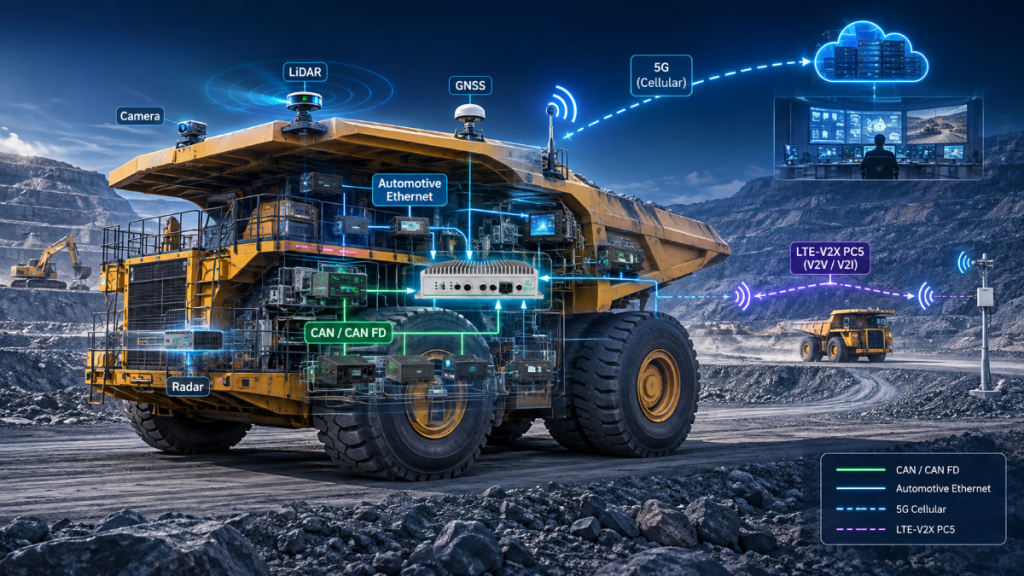
Autonomous mining trucks rely on multiple electronic systems working together to perform navigation, perception, vehicle control, fleet coordination, and remote monitoring. LiDAR sensors, cameras, radar systems, GNSS receivers, onboard computers, chassis controllers, and fleet management platforms all generate or exchange information during vehicle operation.
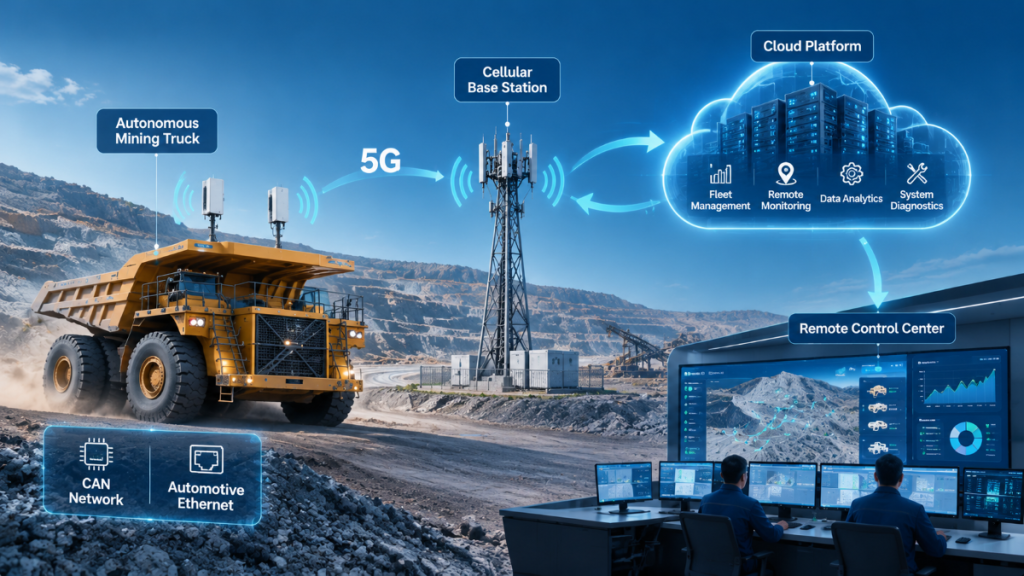
These systems do not necessarily use the same communication technologies. Some exchange data through Controller Area Network (CAN) or CAN with Flexible Data-Rate (CAN FD), while others depend on Automotive Ethernet for higher-bandwidth communication. Cellular connectivity, particularly 5G, provides a connection between the vehicle and external infrastructure such as mine operations networks and cloud platforms.
The challenge is therefore not simply to connect every device to a network. It is to design an integrated communication architecture that accommodates different interfaces, data rates, communication requirements, and operating conditions.
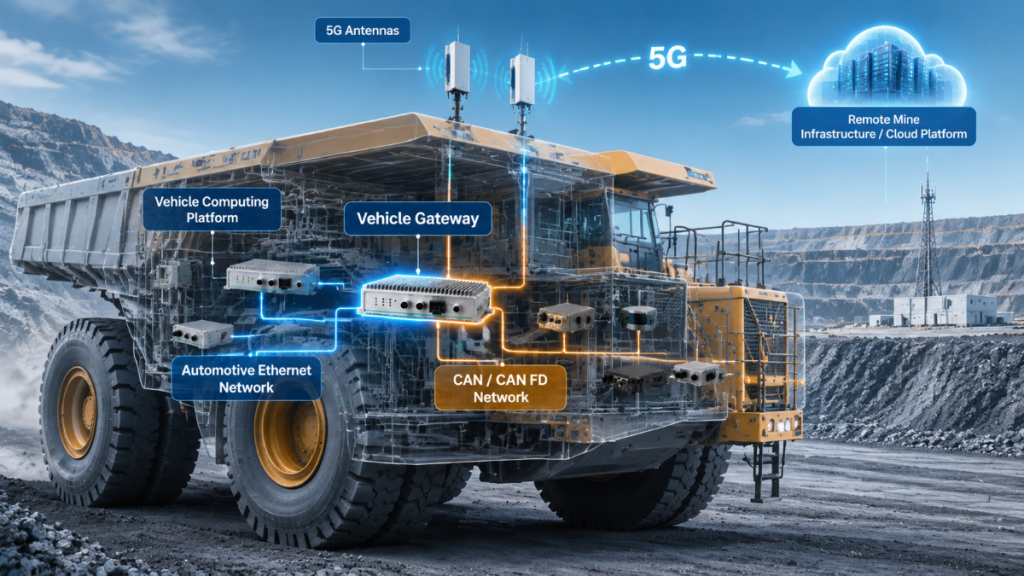
A vehicle communication gateway can play an important role in this architecture. Depending on its hardware and software capabilities, it can connect selected onboard networks with external communication systems, enabling vehicle information to be exchanged with remote monitoring, fleet management, and other network services.
This article examines the communication architecture of autonomous mining trucks, including CAN, CAN FD, Automotive Ethernet, Time-Sensitive Networking (TSN), 5G connectivity, and vehicle gateway integration. It also discusses practical engineering considerations when selecting and deploying communication equipment.
2. Communication Requirements of Autonomous Mining Trucks
2.1 Multiple Electronic Systems and Communication Interfaces
An autonomous mining truck is a distributed electronic system rather than a single computing device.
Depending on the vehicle design and automation solution, its onboard equipment may include:
- LiDAR sensors for environmental perception.
- Cameras for visual monitoring and object recognition.
- Millimeter-wave radar for object detection.
- GNSS and RTK positioning equipment.
- Autonomous driving computers for perception, planning, and decision-making.
- Chassis controllers for vehicle motion and actuator management.
- Vehicle monitoring and diagnostic systems.
- Wireless communication equipment for external connectivity.
These components have different communication requirements.
For example, an autonomous driving computer may exchange large volumes of sensor data through high-speed Ethernet connections. A chassis controller may use CAN or CAN FD to exchange vehicle status and control-related messages. A GNSS receiver may provide positioning information through a serial or Ethernet interface.
Consequently, a mining truck communication architecture usually combines several communication technologies rather than relying on a single network standard.
2.2 Different Data Types Require Different Communication Paths
Not all vehicle data requires the same bandwidth, latency, or transmission characteristics.
A useful approach to network design is to classify traffic according to its function.
Control and status messages
Vehicle operating parameters, diagnostic information, and communication with electronic control units may use CAN or CAN FD. These networks are suitable for structured messages exchanged between vehicle controllers. The actual message definitions and control logic depend on the vehicle manufacturer and the connected electronic systems.
Perception and sensor data
LiDAR point clouds, camera streams, and radar information can generate substantial data volumes. Automotive Ethernet provides higher-bandwidth communication paths for compatible devices and computing platforms that need to exchange this information.
Positioning and synchronization data
GNSS and RTK systems provide positioning information. Time synchronization mechanisms help different onboard systems associate measurements with a consistent time reference. The positioning source and network time-synchronization mechanism serve related but distinct purposes.
External communication data
Vehicle status, fleet telemetry, diagnostic information, mission updates, and selected sensor data may be transmitted to remote systems through cellular or mine communication networks.
The network architecture should therefore consider not only the interface of each device but also the destination, priority, bandwidth, and timing requirements of its data.
2.3 Environmental and Operational Requirements
Mining trucks operate in conditions that differ significantly from ordinary passenger vehicles.
Dust, vibration, temperature fluctuations, electrical interference, and continuous operating cycles can affect communication equipment and physical connections.
Network reliability also depends on the mining environment. Open-pit mines contain changing terrain, slopes, loading areas, roads, and infrastructure that can influence wireless signal coverage. Vehicle routes and operating patterns may also change over time, making coverage validation an ongoing engineering task.
The Global Mining Guidelines Group identifies communication technology selection, network design, redundancy, scalability, and monitoring as important considerations when implementing autonomous systems in mining operations.
This means that vehicle communication equipment must be evaluated as part of the complete operating environment rather than as an isolated hardware component.
3. Overall Communication Architecture of an Autonomous Mining Truck
3.1 Vehicle-Level Communication Architecture
A typical autonomous mining truck communication architecture contains several interconnected components:
- Onboard sensing and positioning equipment.
- Vehicle control and computing systems.
- In-vehicle communication networks.
- Vehicle communication gateway.
- External wireless and mine communication infrastructure.
- Fleet management and remote application platforms.
A simplified conceptual architecture is shown below.
AUTONOMOUS MINING TRUCK
+——————————————————+
| ONBOARD EQUIPMENT |
| |
| LiDAR | Cameras | Radar | GNSS / RTK | Vehicle ECUs |
+—————————+————————–+
|
+————–+—————+
| |
v v
+—————————+ +—————————+
| CAN / CAN FD NETWORK | | AUTOMOTIVE ETHERNET |
| | | NETWORK |
| Chassis ECUs | | Sensors / Computing |
| Vehicle Status | | Platforms / Data Links |
+————-+————-+ +————-+————-+
| |
+—————+————–+
|
Selected Interfaces
|
v
+————————-+
| VEHICLE COMMUNICATION |
| GATEWAY |
| |
| CAN / CAN FD |
| Ethernet |
| Cellular Connectivity |
| Other Supported I/O |
+————+————+
|
+———–+———–+
| |
v v
5G Cellular Network LTE-V2X PC5
| |
v v
Mine Network / Nearby Vehicles /
Core Network Compatible RSUs
|
v
+—————————+
| Remote Application |
| Platforms |
| |
| Fleet Management |
| Dispatch |
| Remote Monitoring |
| Diagnostics |
+—————————+
Conceptual architecture for illustrating communication relationships, not a product wiring diagram. Actual equipment connections and data paths depend on the vehicle manufacturer’s E/E architecture and system integration requirements. Not every sensor or control signal passes through the vehicle gateway. LTE-V2X PC5 is shown separately because it provides direct communication with compatible nearby devices rather than serving as the vehicle’s cellular connection to a cloud platform.
3.2 In-Vehicle Network and External Network Integration
The in-vehicle network and external communication network serve different purposes.
In-vehicle communication connects electronic devices and computing platforms within the truck. It may include CAN, CAN FD, Automotive Ethernet, and other interfaces.
External communication connects the vehicle to mine infrastructure, dispatch systems, remote monitoring platforms, and other services through technologies such as 5G, private LTE, or Wi-Fi.
The vehicle communication gateway can provide an integration point between selected onboard interfaces and external networks.
For example, vehicle status information collected from onboard systems may be forwarded to a remote monitoring platform through a cellular connection. Authorized configuration data or operational information may also be delivered from external systems to onboard equipment when the vehicle architecture and software support the required communication path.
However, the gateway should not automatically be considered the processing center for every vehicle data stream. High-bandwidth sensor traffic may remain within dedicated Ethernet connections between sensors and autonomous driving computers. The actual routing architecture depends on system bandwidth requirements and the responsibilities assigned to each onboard device.
3.3 Typical Data Flow
A practical communication design should identify the source, destination, and purpose of each data flow.
Example 1: Vehicle status monitoring
A chassis controller generates vehicle status messages. These messages are communicated through the vehicle’s CAN or CAN FD network. Where the system design provides the necessary gateway interface and software support, selected information can be forwarded to a remote monitoring platform.
Example 2: Sensor-to-computing communication
LiDAR and cameras connect to an onboard computing platform through suitable Ethernet interfaces. The autonomous driving computer processes the incoming sensor information and performs perception and decision-making.
The vehicle gateway may provide network connectivity for selected devices, but this does not mean it performs LiDAR processing, image recognition, or video encoding.
Example 3: Remote fleet communication
The vehicle gateway establishes a cellular connection to external network infrastructure. Vehicle telemetry, diagnostic information, and other authorized data can then be exchanged with remote services according to the configured network architecture.
These examples illustrate why data-flow planning is essential when defining interfaces, network capacity, and gateway functionality. The actual paths must be verified against the vehicle’s network topology and software responsibilities.
4. In-Vehicle Network: Automotive Ethernet and CAN Communication
4.1 CAN Bus in Mining Vehicles
Controller Area Network (CAN) is widely used in vehicle electronic systems.
CAN provides a message-based communication mechanism that allows multiple electronic control units to exchange information over a shared bus. Instead of relying on individual point-to-point connections for every controller, devices communicate through messages identified by CAN identifiers.
In mining vehicles, CAN may be used for communication between chassis controllers, vehicle monitoring equipment, and other electronic subsystems.
Its advantages include:
- Mature vehicle communication technology.
- Efficient transmission of short control and status messages.
- Built-in error detection mechanisms.
- Support for distributed electronic control systems.
- A relatively simple physical network structure.
However, Classical CAN has limitations in payload size and communication rate. A standard Classical CAN data frame carries up to eight data bytes, and its nominal bit rate can reach 1 Mbps.
These characteristics make CAN suitable for many control and monitoring applications, but less suitable for transporting large volumes of sensor data.
4.2 CAN FD: More Data per Frame
CAN FD, or CAN with Flexible Data-Rate, extends the capabilities of Classical CAN.
According to Bosch, CAN FD increases the maximum payload from eight bytes to 64 bytes per frame. It also supports bit-rate switching, allowing the data phase of a frame to operate at a higher bit rate than the arbitration phase, subject to the network design and physical-layer limitations.
This allows more information to be transmitted in each frame and can improve communication efficiency compared with Classical CAN under appropriate network conditions. CAN FD does not, however, provide the bandwidth characteristics of Automotive Ethernet.
CAN FD controllers can also communicate using Classical CAN frames. However, this does not mean that every Classical CAN-only device can receive CAN FD frames. A Classical CAN-only node cannot correctly process CAN FD frames, so mixed networks must account for the capabilities of every connected controller and device.
For engineering teams, compatibility should be checked at the controller, transceiver, and network level rather than inferred from the presence of a CAN connector alone.
SV910 CAN FD capability
The KEY-IOT SV910 supports three CAN channels, all with CAN FD capability and backward compatibility with Classical CAN.
This provides flexibility when integrating vehicle control networks that use CAN FD while retaining support for conventional CAN-based equipment. The actual communication behavior still depends on the connected devices, CAN configuration, and application-level message definitions.
4.3 Automotive Ethernet: Supporting Higher-Bandwidth Communication
Automotive Ethernet provides Ethernet connectivity within vehicle environments.
Unlike traditional Ethernet interfaces commonly used in office networks, Automotive Ethernet includes physical-layer technologies optimized for vehicle applications.
Two important examples are:
- 100BASE-T1:100 Mbps Ethernet over a single balanced twisted pair.
- 1000BASE-T1:1 Gbps Ethernet over a single balanced twisted pair.
These technologies help reduce cabling requirements while providing higher communication bandwidth than conventional CAN networks.
Automotive Ethernet is useful for connecting compatible cameras, computing platforms, sensor systems, and other devices that require higher data throughput. However, not every camera or LiDAR device uses an Automotive Ethernet T1 interface. Some use conventional Ethernet, while others rely on dedicated high-speed interfaces.
It is important to distinguish the physical interfaces. 100BASE-T1 and 1000BASE-T1 are not directly interchangeable with conventional 100BASE-TX or 1000BASE-T Ethernet ports simply because they use Ethernet protocols. Their physical layers differ. Connecting them requires compatible PHYs or appropriate media-conversion equipment.
For mining vehicles, interface selection should therefore consider the actual Ethernet PHY, link speed, connector, cable, and device compatibility. The T1 designation describes the Ethernet physical-layer technology, not the connector type.
4.4 Integrating CAN and Ethernet in a Mixed Network
CAN and Automotive Ethernet are complementary technologies.
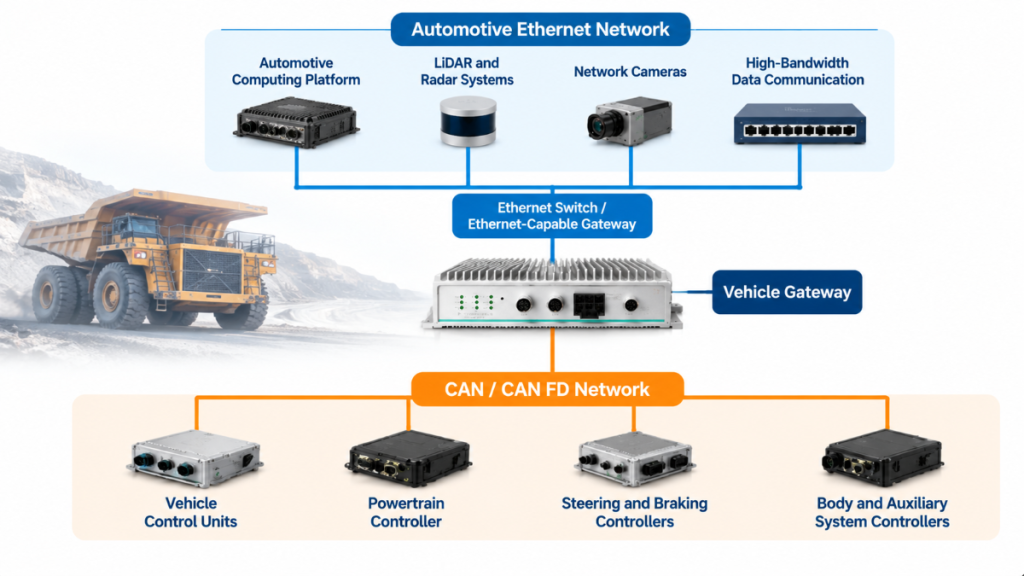
CAN and CAN FD are generally suitable for communication between vehicle electronic control units. Automotive Ethernet is more appropriate for high-bandwidth communication between compatible sensors, computing platforms, and network devices.
A mixed network allows each technology to serve the applications for which it is best suited.
على سبيل المثال:
- Chassis control systems may use CAN or CAN FD.
- LiDAR and camera systems may use compatible Ethernet interfaces.
- Autonomous driving computers may connect to multiple Ethernet networks.
- Vehicle gateways may provide interfaces for both CAN and Ethernet.
- External communication may be provided through 5G or other wireless networks.
A vehicle gateway can help integrate these communication environments, but the presence of both CAN and Ethernet interfaces does not automatically mean that every protocol can be translated between them.
It is useful to distinguish three separate functions:
- Physical connectivity:Providing compatible electrical and physical interfaces.
- Network forwarding:Transmitting traffic between supported network interfaces.
- Protocol or data conversion:Parsing messages and converting them into another protocol or data format.
Protocol parsing, message conversion, filtering, and application-level integration depend on the gateway’s supported software functions and the requirements of the connected devices.
5. 5G Connectivity and Vehicle-to-Cloud Communication
5.1 The Role of 5G in Autonomous Mining Trucks
While CAN and Automotive Ethernet primarily support onboard communication, cellular connectivity provides a wireless communication path between mining vehicles and external infrastructure.
5G can support applications such as:
- Vehicle status and telemetry reporting.
- Remote diagnostics and maintenance.
- Fleet monitoring and dispatch communication.
- Remote configuration and software updates.
- Selected data transmission from vehicles to remote platforms.
- Remote assistance and operational coordination.
The actual performance depends on network coverage, radio conditions, spectrum, infrastructure configuration, device capability, and application requirements.
In an open-pit mine, cellular coverage must be considered across the entire operating area. Terrain, vehicle movement, infrastructure placement, and changes in operating routes can affect signal availability.
A 5G-capable gateway therefore provides the vehicle with cellular connectivity, but it does not eliminate the need for appropriate mine-wide wireless network planning. Network design should be validated along representative haul routes and operating areas rather than based solely on nominal coverage or peak throughput specifications.
5.2 Vehicle-to-Cloud Communication Architecture
A typical vehicle-to-cloud communication path can be represented as:
Onboard Equipment
|
v
In-Vehicle Network
|
v
Vehicle Communication Gateway
|
v
5G Cellular Network
|
v
Mine Network / Core Network
|
v
Remote Application Platform
Depending on the deployment, the remote platform may be hosted in a mine data center, private cloud, or external cloud environment.
The communication architecture should define:
- Which onboard information is transmitted.
- Which remote systems are authorized to receive it.
- How communication sessions are established.
- How network access is controlled.
- How data is protected during transmission.
- What happens when connectivity becomes unavailable.
These considerations are particularly important in mining operations where multiple vehicles may communicate with centralized management systems.
It is also important to distinguish the cellular path from LTE-V2X PC5. Cellular communication through the network infrastructure is typically used for vehicle-to-cloud or vehicle-to-network services. PC5 provides a direct communication path between compatible V2X devices and is not simply another route to the cloud.
5.3 Private 5G, Public 5G, and Wi-Fi
Different wireless technologies can be used in mining environments. The appropriate choice depends on coverage, mobility, deployment cost, network control, and application requirements.
Private 5G
A private 5G network provides a dedicated cellular network environment for an organization or site. It can offer greater control over network configuration, access policies, and resource management.
For mining operations, private 5G may be considered when managed connectivity, site-specific coverage, and integration with mine infrastructure are important.
Public 5G
Public 5G uses mobile network operator infrastructure. It can reduce the need for a mine operator to deploy and maintain its own cellular network, provided suitable coverage and service availability exist.
However, coverage, service characteristics, and network control depend on the operator and local deployment.
الواي فاي
Wi-Fi can provide wireless access in areas where access points can be installed and maintained effectively.
It may be suitable for workshops, loading areas, maintenance facilities, and other locations with defined coverage requirements. Mobile vehicles moving across large operating areas may require careful access-point placement, roaming configuration, and coverage planning.
These technologies are not necessarily mutually exclusive. A mining operation may use cellular and Wi-Fi networks together to meet different connectivity requirements. The selection should be based on the actual vehicle routes, application traffic, site infrastructure, and operating model.
5.4 Network Reliability and Redundancy
Communication reliability is a system-level consideration.
A vehicle may have redundant cellular modules or alternative wireless links, but this alone does not guarantee uninterrupted communication.
The design should consider:
- Availability of different operators or network infrastructures.
- Radio coverage along vehicle routes.
- Cellular module and antenna placement.
- Link monitoring and failure detection.
- Network switching and recovery behavior.
- Application-level reconnection and session handling.
- Common failure points such as shared power supplies or infrastructure.
For example, two cellular connections may still share the same base station, backhaul, or power infrastructure. Redundancy should therefore be evaluated according to the actual network topology.
It is also important to distinguish between several commonly used terms:
- Dual-modem connectivitymeans the hardware contains two cellular modems.
- Active-standby operationmeans one connection is normally used while another is available as a backup.
- Active-active operationmeans multiple connections are used concurrently, subject to the system’s routing and traffic-management design.
- Automatic failovermeans traffic can be redirected when a connection meets defined failure conditions.
- Bandwidth aggregationmeans traffic is distributed or combined across multiple links using a suitable network mechanism.
These functions are not interchangeable. Dual-modem hardware does not, by itself, prove support for active-active operation, automatic failover, seamless session continuity, or bandwidth aggregation.
The Global Mining Guidelines Group also emphasizes redundancy, scalability, and compatibility as important elements of autonomous mining communication infrastructure.
A reliable vehicle communication architecture must combine appropriate onboard hardware with a properly designed external network and validated recovery behavior.
6. The Role of a Vehicle Gateway in Mining Truck Communication
6.1 What Does a Vehicle Gateway Do?
A vehicle communication gateway is an integration device that connects different communication interfaces and can provide access to external networks.
Depending on its hardware and software capabilities, a vehicle gateway may combine:
- CAN and CAN FD interfaces.
- Automotive Ethernet interfaces.
- Standard Ethernet interfaces.
- Cellular communication modules.
- Serial interfaces.
- Digital input and output interfaces.
- Optional positioning or V2X capabilities.
Its role is to provide communication connectivity between selected onboard devices and external systems.
A gateway may also provide network functions such as IP routing, link monitoring, backup connectivity, and remote device management, depending on the product’s implementation.
However, a vehicle gateway should not be confused with an autonomous driving controller or chassis controller. It does not inherently perform sensor fusion, path planning, obstacle recognition, or safety-critical vehicle control. These functions belong to the corresponding vehicle computing and control systems.
6.2 Connecting Onboard Devices and Communication Networks
A vehicle gateway can provide multiple interfaces for connecting different vehicle subsystems.
على سبيل المثال:
- CAN interfaces can connect to vehicle electronic control networks.
- Automotive Ethernet interfaces can connect to compatible onboard network devices.
- Standard Ethernet ports can connect to industrial computers or network equipment.
- Cellular modules can establish connections to external network infrastructure.
- Serial interfaces can connect to compatible legacy devices.
The actual connection arrangement depends on the vehicle architecture.
When planning integration, engineers should identify the communication requirements of every device before assigning gateway interfaces.
This includes physical interface compatibility, data rate, communication protocol, network topology, and whether data must be forwarded to another system.
A further distinction is necessary when connecting cameras and other sensing equipment. Providing an Ethernet connection does not mean that the gateway supports video decoding, video processing, or camera protocol interpretation. Those functions must be provided by the relevant devices or software platforms unless explicitly supported by the gateway.
6.3 Vehicle Gateway vs. Ethernet Switch vs. Industrial Router
These devices may share some networking functions, but they serve different purposes.
بوابة السيارة
A vehicle gateway combines vehicle-oriented interfaces with communication and network functions. Depending on its configuration, it can connect CAN, Automotive Ethernet, standard Ethernet, and cellular networks.
Automotive Ethernet Switch
An automotive Ethernet switch primarily forwards Ethernet frames between connected network ports. Its role is to expand and organize Ethernet connectivity.
Advanced switches may also support VLANs, traffic prioritization, and TSN functions, depending on their hardware and software.
جهاز التوجيه الصناعي
An industrial router primarily provides IP network connectivity, routing, firewall functions, and WAN access through wired or wireless networks.
It may be suitable for connecting industrial equipment to remote networks, but it does not necessarily provide Automotive Ethernet or CAN interfaces.
The correct device depends on the communication architecture rather than the product category alone. In some vehicle designs, a gateway and an Ethernet switch may be used together rather than as alternatives.
6.4 Protocol Integration and Custom Development
Physical connectivity does not automatically provide application-level interoperability.
Two devices may use Ethernet but communicate through different application protocols. Similarly, CAN devices may use different message definitions even when they share the same physical bus.
For this reason, integration projects should distinguish between:
- Physical interface connectivity.
- Network-layer communication.
- Transport protocols.
- Application-layer protocols.
- Data parsing and conversion.
A vehicle gateway may provide the necessary network connection without implementing every application protocol used by connected devices.
Where custom protocol integration is required, the device manufacturer and system integrator should define the source data format, destination format, communication method, and software responsibilities.
For example, connecting a camera to an Ethernet port does not automatically mean that the gateway can decode its video stream. Connecting a CAN device does not automatically mean that the gateway understands the device’s application messages.
This distinction helps avoid assuming that a gateway automatically supports every third-party device or cloud platform.
7. Engineering Considerations for Vehicle Gateway Integration
7.1 Interface and Port Planning
The first step in gateway selection is to prepare a complete interface list for the vehicle.
Engineers should identify:
- The number of CAN and CAN FD connections.
- The number and type of Automotive Ethernet ports.
- Standard Ethernet requirements.
- Serial communication interfaces.
- Cellular connectivity requirements.
- Digital input and output requirements.
- Antenna and SIM/eSIM configurations.
The interface plan should also consider future expansion.
For example, a mining truck may initially use a limited number of Ethernet devices but require additional connections as its autonomous driving system evolves.
Selecting a gateway with sufficient interfaces can reduce the need for additional networking equipment. However, port count alone is not enough. Engineers must also check the physical-layer type, link speed, connector, protocol support, and software functionality of each interface.
7.2 Power Supply and Environmental Adaptability
Mining vehicles experience electrical and environmental conditions that may affect electronic equipment.
Gateway selection should consider:
- Input voltage range.
- Power fluctuation protection.
- Reverse-polarity protection.
- Operating temperature.
- Mechanical vibration.
- Connector locking and retention.
- Enclosure protection.
- Heat dissipation.
These specifications should be evaluated against the actual installation location and vehicle electrical system.
For example, a gateway installed in an enclosed electrical compartment may experience different thermal conditions from equipment mounted in a more exposed location.
Environmental suitability should therefore be verified through product specifications and the vehicle integration design. The gateway’s rated operating conditions should not be treated as a substitute for validating the complete installation.
7.3 Network Capacity and Data Traffic
Network capacity planning should be based on actual traffic requirements.
The bandwidth required by a camera, LiDAR sensor, vehicle controller, or remote monitoring application can vary significantly.
Engineers should estimate:
- Average and peak data rates.
- Number of connected devices.
- Traffic direction.
- Communication frequency.
- Data retention requirements.
- Required external transmission capacity.
An important design consideration is that the capacity of an Ethernet interface does not automatically determine the throughput available through the cellular connection.
For example, a gateway may have Gigabit Ethernet ports while its external 5G throughput depends on the cellular module, radio conditions, operator network, and configuration.
The architecture should also distinguish between local sensor traffic and information that actually needs to leave the vehicle. Not every camera stream or LiDAR point cloud needs to be transmitted through the cellular network.
Where high-bandwidth data must be sent externally, engineers should assess whether local processing, selective data transmission, compression, or edge computing is more appropriate for the application.
7.4 System Integration and Validation
A vehicle communication gateway should be tested as part of the complete vehicle system.
A practical validation process may include:
Interface verification
Check physical connections, link status, port compatibility, and communication parameters.
Protocol verification
Confirm that connected devices can exchange data using the expected protocols and configurations. Where protocol conversion or data parsing is required, verify the actual application-level behavior.
Network performance testing
Measure throughput, latency, packet loss, and link stability under representative operating conditions. Test both onboard network paths and external wireless connections where applicable.
Environmental testing
Evaluate the equipment under the expected temperature, vibration, power, and installation conditions.
Failure and recovery testing
Verify network monitoring, backup connectivity, recovery behavior, and the response of connected applications when communication becomes unavailable. If failover is a project requirement, test detection thresholds, switching behavior, session recovery, and return-to-primary behavior separately.
Long-duration operation
Observe device stability and network behavior during extended operating periods.
Testing should reflect the actual mine environment and vehicle operating conditions. Laboratory results alone may not represent performance across an entire mining route.
8. KEY-IOT Vehicle Gateway Solutions for Autonomous Mining Trucks
KEY-IOT develops vehicle communication gateways for connected and autonomous vehicle applications. Its product portfolio includes SV910 and SV900, which provide different interface configurations and communication capabilities.
Their suitability depends on the vehicle’s network architecture, interface requirements, software integration needs, and operating environment.
8.1 SV910: 5G Vehicle Gateway with Automotive Ethernet and TSN
The KEY-IOT SV910 is a vehicle communication gateway designed for applications requiring multiple onboard communication interfaces, time-sensitive networking capabilities, and cellular connectivity.
Its interface configuration includes:
- Three 1000/100BASE-T1 interfaces.
- Three 100BASE-T1 interfaces.
- Two 1000/100BASE-TX Ethernet interfaces with M12 connectors.
- Three CAN interfaces, all supporting CAN FD and backward compatibility with Classical CAN.
- One RS232 interface.
- One RS485 interface.
- Two digital inputs and two relay outputs.
- DC 9–48V power input.
The device supports optional dual 5G or 5G combined with 4G/RedCap cellular configurations. The selected configuration should be matched to the project’s cellular requirements. RedCap is part of 5G NR, rather than a separate cellular generation.
Automotive Ethernet and CAN FD Integration
The combination of Automotive Ethernet and CAN FD interfaces allows SV910 to connect different vehicle communication networks.
The T1 interfaces support compatible Automotive Ethernet equipment, while the CAN FD interfaces provide connectivity to vehicle electronic control networks.
This mixed-interface architecture is relevant to autonomous mining trucks that integrate high-bandwidth sensing equipment with conventional vehicle control systems. Engineers should still verify the PHY, link speed, connector, cable, and software requirements of each connected device.
Time-Sensitive Networking
SV910 supports the following IEEE Time-Sensitive Networking standards:
| IEEE Standard | Main Function |
| IEEE 802.1AS-2020 | Time synchronization for time-sensitive network applications |
| IEEE 802.1Qat | Stream Reservation Protocol (SRP) |
| IEEE 802.1Qav | Credit-Based Shaper for traffic management |
| IEEE 802.1Qbu | Frame preemption |
| IEEE 802.1Qbv | Time-aware traffic scheduling |
| IEEE 802.1Qci | Per-stream filtering and policing |
| IEEE 802.1Qcr | Asynchronous Traffic Shaping |
| IEEE 802.1CB | Frame Replication and Elimination for Reliability (FRER) |
These standards address different aspects of TSN rather than providing one single function:
- Time synchronization:IEEE 802.1AS-2020 establishes synchronized time across compatible bridged networks.
- Traffic management and scheduling:IEEE 802.1Qav, 802.1Qbv, and 802.1Qcr provide different mechanisms for shaping or scheduling network traffic. IEEE 802.1Qbu supports frame preemption.
- Stream management and reliability:IEEE 802.1Qci provides per-stream filtering and policing, while IEEE 802.1CB specifies frame replication and elimination mechanisms for redundant Ethernet paths.
- Stream reservation:IEEE 802.1Qat defines the Stream Reservation Protocol. Its functionality has subsequently been incorporated into later revisions of the broader IEEE 802.1Q standard family.
SV910 also supports hardware-based IEEE 1588v2 Precision Time Protocol (PTP).
IEEE 802.1AS is based on an IEEE 1588 profile for timing and synchronization in bridged local area networks. It should therefore not be treated as an entirely separate timing technology from PTP. The two standards address synchronization in different scopes and profiles.
KEY-IOT specifies nanosecond-level synchronization accuracy for SV910’s hardware-based PTP capability. Actual synchronization performance in a deployed system depends on the timing configuration, network topology, connected devices, measurement conditions, and other implementation factors. It should not be interpreted as a guaranteed end-to-end accuracy for every network configuration.
TSN performance is also a property of the configured network, not simply an individual device. Connected switches, endpoints, network topology, traffic configuration, and timing architecture must support the required functions. A gateway’s support for multiple TSN standards does not, by itself, establish that an entire vehicle network is operating as an end-to-end TSN system.
LTE-V2X PC5 Connectivity
SV910 supports LTE-V2X PC5 direct communication.
PC5 is the direct communication interface used by LTE-V2X systems. It enables compatible vehicles and roadside infrastructure equipment to exchange V2X messages directly over the PC5 link, rather than routing every message through the cellular network infrastructure.
In mining environments, LTE-V2X PC5 can support vehicle-to-vehicle and vehicle-to-infrastructure communication applications where compatible equipment, application protocols, and system integration are available.
PC5 should be distinguished from the vehicle’s 5G cellular connection. It is not another WAN path to a cloud platform, and support for PC5 alone does not establish that a complete V2X application is deployed. The actual application depends on compatible V2X equipment, configuration, and deployment architecture.
8.2 SV900: 5G Vehicle Gateway for Unmanned Vehicle Connectivity
The KEY-IOT SV900 is another vehicle gateway designed for unmanned vehicle and mobile equipment applications.
It provides a combination of Ethernet, serial, CAN, and cellular connectivity.
Its main interface configuration includes:
- Five M12 Ethernet interfaces, including a software-configurable LAN/WAN port.
- One RS232 interface.
- One RS485 interface.
- One CAN interface.
- Optional dual 5G or 5G combined with 4G/RedCap cellular configurations.
- DC 9–48V power input.
The SV900 supports Linux secondary development, allowing customers to develop and integrate applications according to project requirements.
Its documented software capabilities include support for NTRIP, GPS/BeiDou positioning-related functions, Modbus RTU/TCP, Siemens S7 data acquisition, and northbound communication using protocols and formats such as TCP, MQTT, HTTP, and JSON. It also supports remote device management functions, including configuration, monitoring, and firmware updates.
These capabilities can be relevant to unmanned vehicle projects that need to connect vehicle equipment with external management or application platforms.
For projects involving additional third-party devices or cloud platforms, the exact integration requirements should be evaluated separately. Custom protocol parsing, data-format conversion, or application development may be required when the standard functions do not cover the project’s requirements.
إن SV900 is therefore suitable for projects that need a vehicle-oriented communication gateway with Linux-based software development and a different interface configuration from SV910.
8.3 How to Select the Right Vehicle Gateway
The selection process should begin with the vehicle’s communication architecture rather than the gateway’s headline specifications.
| Selection Factor | Engineering Consideration |
| CAN / CAN FD | Number of vehicle network connections, CAN FD compatibility, and required message handling |
| إيثرنت السيارات | Number of T1 interfaces, PHY type, and supported link speeds |
| Standard Ethernet | Connectivity to industrial computers and other network equipment |
| Cellular connectivity | Dual 5G or 5G combined with 4G/RedCap requirements |
| TSN | Required synchronization, traffic scheduling, and reliability functions |
| V2X | Whether direct LTE-V2X PC5 communication is required |
| Software integration | Need for Linux development, protocol adaptation, or data conversion |
| Environmental conditions | Power input, temperature, vibration, mounting, and connector requirements |
For systems with multiple Automotive Ethernet connections, three CAN FD channels, TSN, and LTE-V2X PC5 requirements, SV910 provides a more extensive interface configuration.
For projects with different interface requirements and a need for Linux-based software development, SV900 may be considered.
The final choice should be based on the actual device list, network topology, software requirements, environmental conditions, and validation results. Where third-party protocol adaptation or platform integration is required, those software requirements should be defined separately from the hardware interface specification.
9. Frequently Asked Questions
What communication protocols are commonly used in autonomous mining trucks?
Autonomous mining trucks commonly use a combination of CAN, CAN FD, Ethernet, and wireless communication technologies.
CAN and CAN FD support communication between vehicle electronic control units. Automotive Ethernet provides higher-bandwidth connectivity for compatible sensors and computing platforms. Cellular networks such as 5G provide communication between vehicles and external infrastructure.
The exact combination depends on the vehicle manufacturer and autonomous driving system.
What is the difference between CAN FD and Automotive Ethernet?
CAN FD is an extension of the CAN protocol that supports larger data payloads and faster data transmission during the data phase.
Automotive Ethernet provides higher-bandwidth Ethernet connectivity over vehicle-oriented physical interfaces such as 100BASE-T1 and 1000BASE-T1.
CAN FD is generally used for vehicle control and status communication, while Automotive Ethernet is often used for high-bandwidth sensor and computing connections. They serve complementary roles in a vehicle communication architecture.
Why do autonomous mining trucks need a vehicle communication gateway?
A vehicle communication gateway provides connectivity between selected onboard communication networks and external systems.
Depending on its configuration, it can integrate CAN, CAN FD, Automotive Ethernet, standard Ethernet, serial, and cellular interfaces.
This allows selected vehicle information to be exchanged with remote monitoring, fleet management, and other external platforms. Its exact functions depend on the gateway’s supported hardware and software capabilities.
What is the role of 5G in autonomous mining trucks?
5G provides wireless connectivity between vehicles and external infrastructure.
Typical applications include vehicle telemetry, fleet monitoring, remote diagnostics, operational coordination, and selected data transmission.
5G complements the in-vehicle network rather than replacing CAN or Automotive Ethernet.
What is TSN in automotive communication?
Time-Sensitive Networking is a set of IEEE 802.1 standards that extend Ethernet with mechanisms for time synchronization, traffic scheduling, traffic shaping, and communication reliability.
In automotive communication systems, TSN can help coordinate time-sensitive traffic across compatible Ethernet networks.
Its effectiveness depends on the supported standards, network configuration, and capabilities of connected devices. A TSN-capable gateway alone does not make an entire network an end-to-end TSN system.
What is LTE-V2X PC5 communication?
LTE-V2X PC5 is a direct communication interface used by LTE-based Vehicle-to-Everything systems.
It allows compatible vehicles and roadside equipment to exchange V2X messages directly over the PC5 interface. Unlike communication through the cellular Uu interface, PC5 direct communication does not require every message to pass through a cellular base station.
PC5 is a direct V2X communication path, not a replacement for the vehicle’s cellular connection to cloud or fleet management platforms.
Does a vehicle gateway process LiDAR and camera data?
Not necessarily.
A vehicle gateway may provide Ethernet connectivity for LiDAR sensors, cameras, and onboard computers. However, network connectivity does not mean that the gateway performs point-cloud processing, image recognition, or video encoding.
These functions are generally performed by the corresponding sensor devices and autonomous driving computing platforms unless the gateway explicitly supports additional processing functions.
Can a vehicle gateway connect CAN and Ethernet networks?
A gateway may provide both CAN and Ethernet interfaces, allowing it to connect to different vehicle communication networks.
However, physical connectivity does not automatically provide protocol conversion.
CAN-to-Ethernet data forwarding, message parsing, filtering, and application-level conversion depend on the gateway’s supported software functions and the integration requirements.
Does a dual 5G vehicle gateway guarantee uninterrupted connectivity?
No. Dual 5G hardware provides two cellular modem resources, but uninterrupted connectivity depends on the network architecture and software implementation.
Engineers must separately verify simultaneous connection capability, link monitoring, failover logic, session recovery, network diversity, and any bandwidth aggregation functions required by the application.
Two cellular links may also share common infrastructure, so dual-modem hardware alone does not eliminate every potential point of failure.
10. Conclusion
Autonomous mining truck communication architecture requires more than high-speed wireless connectivity. It involves the integration of vehicle control networks, high-bandwidth sensor communication, positioning systems, time synchronization, and external network access.
CAN and CAN FD provide communication for vehicle electronic systems, while Automotive Ethernet supports higher-bandwidth connections between compatible sensors and computing platforms. TSN introduces mechanisms for time synchronization, traffic management, and Ethernet network reliability. Cellular technologies such as 5G provide connectivity between vehicles and mine infrastructure, while LTE-V2X PC5 supports direct communication between compatible V2X devices.
A vehicle communication gateway connects selected parts of this architecture. Its value lies in providing the interfaces and network functions needed to integrate onboard equipment with external communication systems. Its capabilities should be evaluated according to actual interface support, software functions, and project requirements rather than inferred from the gateway category alone.
For mining vehicle manufacturers and autonomous driving system integrators, gateway selection should be based on interface compatibility, network architecture, communication requirements, software integration, and environmental conditions.
By designing these elements together, engineering teams can build a more structured, scalable, and maintainable communication foundation for autonomous mining vehicles.
Need a Vehicle Gateway for Your Autonomous Mining Truck Project?
Selecting the right vehicle communication gateway requires more than matching interface specifications. It also involves understanding the vehicle network architecture, connected equipment, communication protocols, and external connectivity requirements.
KEY-IOT provides vehicle communication gateways for connected and autonomous vehicle applications, with support for CAN FD, Automotive Ethernet, 5G connectivity, TSN, and LTE-V2X PC5 in applicable product configurations.
Contact our engineering team to discuss your vehicle communication requirements, interface configuration, and potential integration solutions.
Explore KEY-IOT Vehicle Gateway Solutions or Contact Our Team.
Author: Neo Cheng — Content Lead at Key-IoT, responsible for technical content strategy and editorial development covering automotive Ethernet, vehicle communication gateways, in-vehicle network integration, and connectivity solutions for autonomous vehicles.
Technical Review: Key-IOT Automotive Connectivity Engineering Team — responsible for reviewing technical concepts, network architecture, product specifications, and engineering application details.
 English
 Español de Perú
 Русский
 العربية
 日本語
 简体中文
 Français
 Deutsch
 繁體中文